Despite claims that urban truck traffic continues to rise, recent data shows no real increase in urban vehicle miles traveled. Online shopping may be helping keep people off the roads.


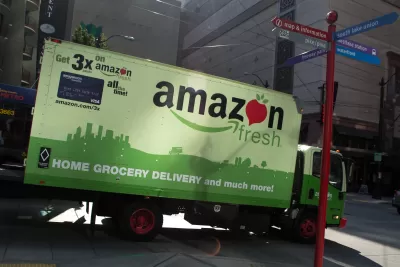
For Brookings, Adie Tomer wrote a piece in July in which "he marshals several decades of data on urban truck VMT to claim that urban truck traffic is up an eye-popping 800 percent since 1966." In this article, Joe Cortright challenges the idea that e-commerce has clogged city roads with delivery trucks.
Cortright points to inconsistencies in the US DOT data centered around changes made in 2006. "The cumulative result of these changes is that it is very difficult to make statistically valid statements about the change in truck traffic in cities."
Recent data shows no preponderance of trucks. "If we look only at the post-2006 data, a very different picture emerges. For the past six years [...] there is little evidence that urban truck traffic is increasing. If anything, the data suggest that it is flat to decreasing."
E-commerce certainly reduces the number of shopping trips people take by car. And recent adjustments in truck delivery routes and algorithms have made the whole business of delivery more efficient. From the article: "Far from a putative cause of worry about transportation system capacity–and inevitably, a stalking horse for highway expansion projects in urban areas–the growth of e-commerce should be seen as another force that is likely to reduce total vehicle miles of travel."
Read the full story: Growing e-commerce means less urban traffic

Rethinking Retail Space in the Wake of COVID-19
As e-commerce boomed and people sought outdoor shopping and dining options, the pandemic accelerated the decline of massive, merchandise-oriented retail spaces and indoor malls.
Addressing Online Retail's Ceaseless Curbside Deliveries
The rise of online retail has come with a flurry of delivery trucks that don't always have good places to stop. Researchers from Amazon's hometown are on the case.
Ross May Be Immune from the Amazon Effect
Ross Stores continues its expansion in the face of a much-foretold retail apocalypse. The shopping experience it provides may be one reason it can stand up to Amazon.

Planetizen Federal Action Tracker
A weekly monitor of how Trump’s orders and actions are impacting planners and planning in America.

California plans to bury El Niño’s downpour
If the state plays its cards right, it may be able to store a billion acre-feet of El Niño’s water in aquifers.

Chicago breaks ground on $3 billion megadevelopment
The new neighborhood, titled Foundry Park, will one day host 3,700 residences.

Satanic Place Names
From streams and lakes to valleys and canyons, I mapped more than 1,000 places named after the Devil.

California High-Speed Rail Authority CEO resigns after $600,000 scandal
Under Ian Choudri, the authority used taxpayer dollars to fund first class flights and trips to nightclubs.

Want to study the Missouri River? Soon, you may need unanimous approval from 10 states
Legislation would require 10 governors’ permission to study or build projects moving water outside the basin.

FREE Course: Walkable City 1: Why Walkability?
After describing his path towards focusing on walkability as the essence of good planning, Jeff Speck marches through his five principal reasons for making more walkable places.
Reinventing Malls: Planning Alchemy—Turning Gray Fields Into Gold
The course focuses on the opportunities and imperatives that shape reinvention of mall sites.


City of Rosemead
Rutgers University, Edward J. Bloustein School of Planning and Public Policy
One Hundred Miles
Hunter College, City University of New York (CUNY)
The Architects Foundation
University of Cincinnati Online
City of Cambridge
Montrose County
The Pocatello Development Authority