The privately funded, diesel-powered trains will run at speeds up to 79 mph between West Palm Beach and Fort Lauderdale, with an extension to Miami opening early next year. Real estate development is key to profitability.


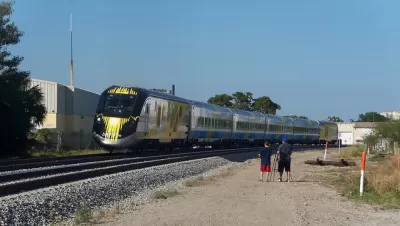
"The ambitious $3 billion Brightline express project will run along the state's densest population corridor with more than 6 million residents and a regular influx of tourists," reports Samantha Raphelson for WBUR News on Dec 7. According to the WBUR map [jpg], the trip from West Palm Beach to Fort Lauderdale will take 30 minutes and another 30 minutes to Miami when service begins.
The project, funded by All Aboard Florida, represents the first test into the long-awaited U.S. move into high-speed rail, says John Renne, director of the Center for Urban and Environmental Solutions at Florida Atlantic University.
Brightline is 'higher-speed rail,' not high-speed rail, which would require electrification (includes maglev rail) and grade separations at speeds above 125 mph, according to the Federal Railroad Administration. An extension to Orlando will enable speeds up to 125 mph. The trains will be powered by EPA Tier 4 compliant locomotives manufactured in Siemens' Sacramento, Calif. plant, which will also built the passenger cars.
"It's the first time that it's happening, being built by a private company," [Renne] tells Here & Now's Jeremy Hobson. "And that's kind of a game changer for this type of model."
“On a national level, the scale of impact could be enormous. It’s a proof of concept for private financing corridor-based infrastructure,” says Adie Tomer, a fellow at the Brookings Institution Metropolitan Policy Program, in a piece by Chris Persaud in Next City on Oct 23, 2017.
Profits to come from real estate, not train tickets
Beyond slashing travel times, Renne says the construction of private mixed-use real estate developments at each station will bring in hundreds of millions of dollars in new revenue. He explains that potential revenue was lost when the government shifted control of transportation to the public sector in the 1920s [or 30s].
When that happened, we lost the connection between the development around the stations and the rail service itself, and we started building a lot of parking lots around the stations," he says. [Renne expands on the relationship between real estate development and train profitability in the audio version].
"The research shows that the transportation service itself rarely makes a profit," he says. "But when you combine the real estate and development opportunities with the transportation service, you can ... actually get to a very profitable outcome."
Unlike the nation's two high-speed rail projects in Texas and California, Brightline will operate in a corridor already owned by All Aboard Florida's parent company, Florida East Coast Industries. "The return to passenger trains will revive a line that stopped running on those old tracks in the 1960s, with the arrival of the federal highway program," writes Raphelson.
Opposition
Like it's semi-counterpart in California, the rail line has sparked litigation by jurisdictions in the corridor. "Two counties along the wealthy Treasure Coast sued to stop the Brightline project, arguing it poses significant safety concerns and would likely delay commuters in cars," adds Raphelson. "Most of those lawsuits have been tossed out or dropped."
The boating industry has also raised objections due to the requirement that drawbridges remain down for trains to use them.
Fares
A 2015 study commissioned by the company suggests it will cost at least $16 to travel from West Palm to Miami – about $10 more than the price to travel a similar route on South Florida's government-run passenger train.
Renne is also extensively quoted in the October Next City piece that goes into much greater depth on the political opposition, and support, along the Treasure Coast.
FULL STORY: Florida Set To Launch Country's First Private High-Speed Train Service

Hurricane Ian Puts Renewed Focus on Florida's Barrier Islands
Ian did not impact Southeast Florida, but coastal residents there took notice of the state's deadliest hurricane since 1935 that devastated much of Southwest Florida last month, particularly the barrier islands off the Gulf Coast.
Fatalities Mount from Brightline, South Florida's New Higher-Speed Train Service
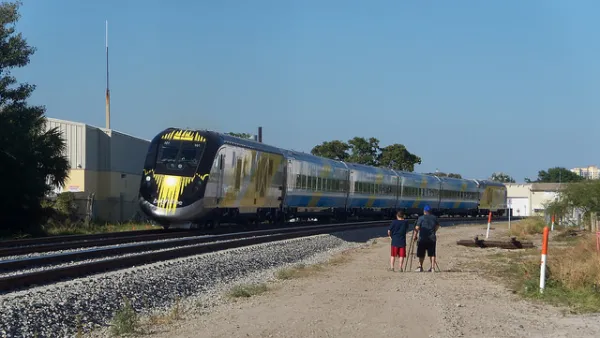
A 51-year-old bicyclist became the second fatality in the first week of revenue service. It was the fourth fatality since the summer for the diesel train, which operates from West Palm Beach to Fort Lauderdale.
Nation's Only Privately Funded Express Rail Service to Launch in July
Good and bad news for followers of Brightline, a South Florida rail start-up. Service between West Palm Beach and Fort Lauderdale begins in July, with Miami soon thereafter, but opponents may hamper extension to Orlando.

The state-sanctioned urbicide of Austin
People don’t kill cities. Freeways do.

US to reduce Colorado River water deliveries to Mexico
A new Colorado Treaty amendment reduces Mexico’s Colorado River water allocation by 250,000 acre feet.

New Jersey’s second-largest city bans standalone data centers
Jersey City will continue to allow co-location facilities, such as those meant for research institutions that store their own data.

Amtrak not solely to blame for New Jersey commuter rail's unreliability, report finds
A new study from the Garden State Initiative found that NJ Transit’s budget grew 20% across a 4 year period, but reliability declined significantly over the same period.

EPA erases limits on planet-warming pollution from power plants
Under Monday’s plan, power plants would still have some limits on how much mercury, arsenic and other contaminants they can emit.

Phoenix announces new on-demand transit service, more frequent RAPID buses
Both new services will launch in October, and are part of Phoenix's Project Effective Access Solutions for Easing Congestion.

FREE Course: Walkable City 1: Why Walkability?
After describing his path towards focusing on walkability as the essence of good planning, Jeff Speck marches through his five principal reasons for making more walkable places.
Reinventing Malls: Planning Alchemy—Turning Gray Fields Into Gold
The course focuses on the opportunities and imperatives that shape reinvention of mall sites.

Eagle County Government
Harvard University Graduate School of Design
Nashville Planning Department
The Architects Foundation
University of Cincinnati Online
The Pocatello Development Authority
The Urban Renewal Agency of the City of Pocatello
Journal of the American Planning Association