Wired takes a tour of a Siemens factory in California tasked with the task of building the rolling stock for the forthcoming, privately-funded Brightline train line in Florida.


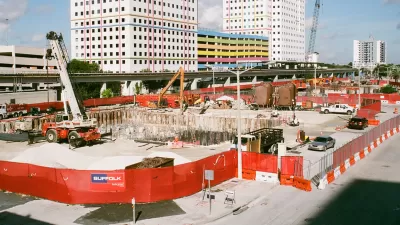
Jack Stewart reports from a factory near Sacramento, where Siemens "is building some of the most modern, high tech, high speed trains to hit US rails."
The trains are being built for service on the Brightline, which until recently was known as All Aboard Florida. The route will connect Miami, Fort Lauderdale, West Palm Beach, and Orlando, with trains traveling up to 125 miles per hour, according to Stewart.
The article's main purpose is to explain how the trains being constructed at the Siemens factory embody the future of train travel in the United States:
That translates to things like extra-large “picture windows” that align with each seat for the best views. Passengers get access to Wi-Fi (which is promised to be the actually useful high-speed variety), tons of power outlets, and reclining seats. To accommodate those traveling with children and luggage as well as older, mobility-impaired passengers—demographics that make up a large part of the anticipated Florida ridership—the trains offer wide aisles and overhead luggage storage.
Read the full story: Step Into the Huge Factory Forging America’s Fancy New Trains

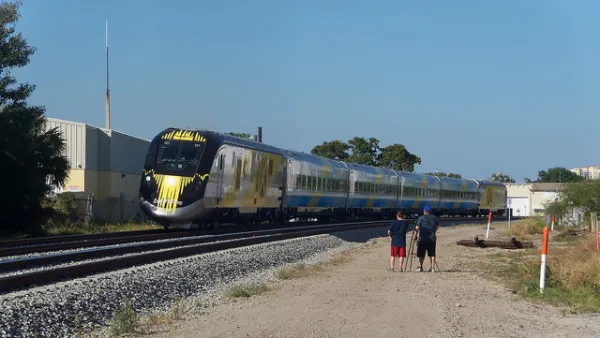
Nation's Only Privately Funded Express Rail Service to Launch in July
Good and bad news for followers of Brightline, a South Florida rail start-up. Service between West Palm Beach and Fort Lauderdale begins in July, with Miami soon thereafter, but opponents may hamper extension to Orlando.

January Must-Reads: Top 10 Articles From Last Month
New York and New Jersey enact new tenant protections, Brightline West announces an opening date, and could a Nevada law have killed tens of thousands of trees?
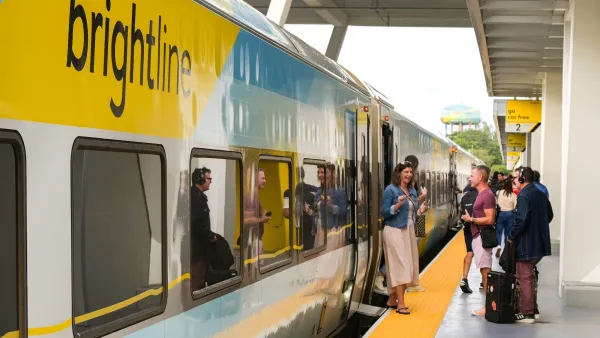
Brightline’s Bond Rating Lowered to ‘Junk’ Status as Debt Mounts Despite High Ridership
The high-speed rail operator faces a $1.2 billion debt load and has never turned a profit since it launched in 2017.

Planetizen Federal Action Tracker
A weekly monitor of how Trump’s orders and actions are impacting planners and planning in America.

California plans to bury El Niño’s downpour
If the state plays its cards right, it may be able to store a billion acre-feet of El Niño’s water in aquifers.

Chicago breaks ground on $3 billion megadevelopment
The new neighborhood, titled Foundry Park, will one day host 3,700 residences.

California High-Speed Rail Authority CEO resigns after $600,000 scandal
Under Ian Choudri, the authority used taxpayer dollars to fund first class flights and trips to nightclubs.

Want to study the Missouri River? Soon, you may need unanimous approval from 10 states
Legislation would require 10 governors’ permission to study or build projects moving water outside the basin.

Desperate measures: Advocates weigh draining Lake Powell to fill Colorado River
Draining the reservoir could reduce evaporation losses by a couple hundred thousand acre-feet.

FREE Course: Walkable City 1: Why Walkability?
After describing his path towards focusing on walkability as the essence of good planning, Jeff Speck marches through his five principal reasons for making more walkable places.
Reinventing Malls: Planning Alchemy—Turning Gray Fields Into Gold
The course focuses on the opportunities and imperatives that shape reinvention of mall sites.

City of Rosemead
Rutgers University, Edward J. Bloustein School of Planning and Public Policy
One Hundred Miles
Hunter College, City University of New York (CUNY)
The Architects Foundation
University of Cincinnati Online
City of Cambridge
Montrose County
The Pocatello Development Authority