Colorado Springs and El Paso County voters agreed to add the highway widening to a list of projects that a regional transportation authority can fund. They passed an additional funding measure enabling county funds to be spent rather than refunded.


Among the nation's local infrastructure ballot measures decided by voters on Tuesday was the passage of two measures in Colorado's Front Range that may bring some relief, eventually, to motorists who drive a 17-mile stretch of Interstate 25 between El Paso and Douglas counties.
"Issue 5B will add the so-called I-25 'Gap' to a list of projects that the Pikes Peak Rural Transportation Authority [PPRTA] can fund and set aside $10 million for the widening in future tax revenues - if state and local leaders can come up with the rest of the money needed to pay for the project's estimated cost of $350 million," reports Rachel Riley for The Gazette on Nov. 7. It was approved with 66 percent of the vote.
The other measure, Issue 1A, was arguably more significant because of its impact on the Colorado Taxpayer Bill of Rights (TABOR), "a constitutional measure that limits the annual growth in state (and sometimes local) revenues," according to the Center on Budget and Policy Priorities. It asked voters to decide on $14.5 million of 'excess' revenue per the TABOR formula determined by population growth and inflation.
It's passage means that El Paso County can "collect and keep more tax revenue this year and in all future years," explains the Colorado Springs Independent.
The county promised that if 1A passed it would spend up to $12 million for a local match for the Interstate 25 gap project and other road projects, with the rest of the 2016 money going to disaster recovery projects and parks, trails and open space.
Had voters rejected the measure, it would have meant that the $14.5 million would have been refunded to taxpayers. "Property owners would have been refunded with tax credits, such as a $40 credit for the owner of a $250,000 home," reports Riley in a separate article on Issue 1A.
Revenue from Issue 5B is derived from a one percent sales tax voters approved in 2004 that goes to PPRTA.
Toll lanes coming....
"Under the current proposal, one lane - a toll lane - would be added in each direction of the roughly 17-mile stretch of interstate [from Monument to Castle Rock in Douglas County]," reports Riley.
A federal grant could generate up to $65 million for construction. If the project wins the highly-competitive grant, a state commission decided last month that the Colorado Department of Transportation [CDOT] will contribute $250 million more under a new law that's expected to generate money for infrastructure projects through the sale of state-owned buildings. Local entities would be expected to provide the remaining $35 million.
State transportation officials have said construction could begin in mid-2019 and end in 2021 if funding sources can be finalized.
The toll lanes are in addition to the current widening of the I-25 Gap by CDOT.
Hat tip to James Brasuell.
FULL STORY: Voters overwhelmingly back regional tax for I-25 widening

Strong Opposition to Toll Lane Additions Expressed in Colorado
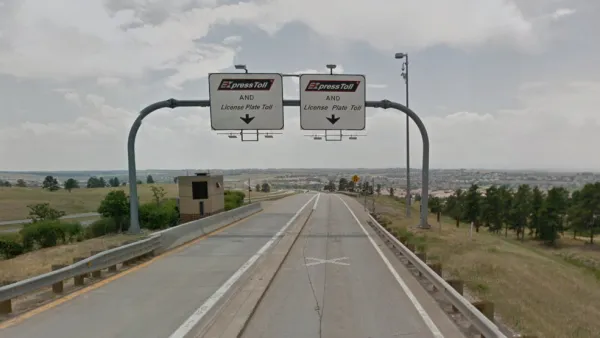
It's not the widening of Interstate 25 that rattled attendees of the public meeting held by the Colorado Department of Transportation on Dec. 7—it's the fact that that they would have to pay to use the new lanes.
Widening, Toll Lane Project Moves Forward in Colorado
A proposed project that would widen and add toll lanes to a section of the I-25 freeway between Colorado Springs and Denver has received a key chunk of funding.
As Community's Colorado's Front Range Grows, Road Planning Follows
Transportation planners are creating extra road capacity to keep up with sprawling development in the I-25 corridor in Colorado's Northern Front Range.

The state-sanctioned urbicide of Austin
People don’t kill cities. Freeways do.

US to reduce Colorado River water deliveries to Mexico
A new Colorado Treaty amendment reduces Mexico’s Colorado River water allocation by 250,000 acre feet.

New Jersey’s second-largest city bans standalone data centers
Jersey City will continue to allow co-location facilities, such as those meant for research institutions that store their own data.

Amtrak not solely to blame for New Jersey commuter rail's unreliability, report finds
A new study from the Garden State Initiative found that NJ Transit’s budget grew 20% across a 4 year period, but reliability declined significantly over the same period.

EPA erases limits on planet-warming pollution from power plants
Under Monday’s plan, power plants would still have some limits on how much mercury, arsenic and other contaminants they can emit.

Phoenix announces new on-demand transit service, more frequent RAPID buses
Both new services will launch in October, and are part of Phoenix's Project Effective Access Solutions for Easing Congestion.

FREE Course: Walkable City 1: Why Walkability?
After describing his path towards focusing on walkability as the essence of good planning, Jeff Speck marches through his five principal reasons for making more walkable places.
Reinventing Malls: Planning Alchemy—Turning Gray Fields Into Gold
The course focuses on the opportunities and imperatives that shape reinvention of mall sites.

Eagle County Government
Harvard University Graduate School of Design
Nashville Planning Department
The Architects Foundation
University of Cincinnati Online
The Pocatello Development Authority
The Urban Renewal Agency of the City of Pocatello
Journal of the American Planning Association