A microcosm of development in the United States, a suburban strip near Chicago has seen a proliferation of restaurant development in recent years, fueled by Wall Street.


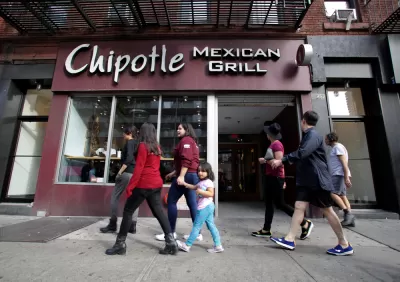
Experts say there is an oversaturation of restaurants across the country. Rachel Abrams and Robert Gebeloff, writing for The New York Times, featured a stretch of Highway 59 in suburban Chicago, Illinois, as a prime example of the type of sprawling development attracting the overbuilding of restaurants in the United States.
Driven by Wall Street investment, restaurants are now opening at twice the rate of population growth, according to the Bureau of Labor Services (BLS). Americans spend 44 cents of every food dollar on restaurants, a figure that is increasing. While restaurant spending is still increasing, its overall growth rate is slowing, creating a glut of restaurants.
Investors such as private equity firms and large banks receive a steady stream of franchise fees and royalty payments while franchisees shoulder much of the risk by having to a actually run the restaurants. There is increased pressure to open more restaurants, as buying a single restaurant may come with a development agreement to open several more.
Read the full story: Thanks to Wall St., There May Be Too Many Restaurants

The Restaurant Industry’s ‘Missing Middle’
Locally owned restaurants affordable to middle-income families are disappearing or being forced to raise prices as costs grow.

DC ‘Streatery’ Fees Could Kill Most Outdoor Dining
The new, permanent outdoor dining program will cost businesses $20 per square foot of dining space, prompting most restaurants to dismantle their Covid-era ‘streateries.’
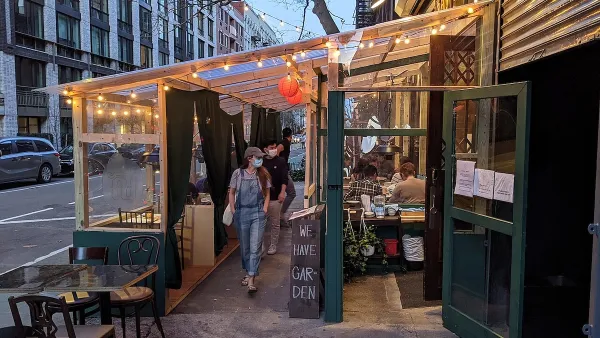
Restaurant Patios Were a Pandemic Win — Why Were They so Hard to Keep?
Social distancing requirements and changes in travel patterns prompted cities to pilot new uses for street and sidewalk space. Then it got complicated.

Planetizen Federal Action Tracker
A weekly monitor of how Trump’s orders and actions are impacting planners and planning in America.

Amtrak, CN end decades-long dispute with eight-year agreement
The new operating agreement establishes an updated framework for the companies to work together, including processes to resolve disputes.

Judges permit Denver to divert 77,000 acre feet from the Colorado River for reservoir expansion
Overuse and climate change have caused the Colorado River’s water levels to plummet.

NYC DOT wants faster, more permanent street upgrades
The city is examining ways to build more concrete infrastructure without getting entangled in 'decades-long' projects.

'Something we’ve never seen before:' rising utility rates could strain city finances nationwide
Data centers, climate change and other factors have caused utility rates in the United States to increase by 38% since 2020.

Trump to overrule local leaders, lease millions of acres of America’s Pacific Island territories’ seafloors to mining companies
International law says that the Indigenous people of America’s territories have a right to prior and informed consent regarding projects that impact their countries.

FREE Course: Walkable City 1: Why Walkability?
After describing his path towards focusing on walkability as the essence of good planning, Jeff Speck marches through his five principal reasons for making more walkable places.
Reinventing Malls: Planning Alchemy—Turning Gray Fields Into Gold
The course focuses on the opportunities and imperatives that shape reinvention of mall sites.

Harvard University Graduate School of Design
KFH Group Inc.
Greater Baltimore Committee
The Architects Foundation
University of Cincinnati Online
The Pocatello Development Authority
The Urban Renewal Agency of the City of Pocatello