In participatory planning, there is no planning without several events known as charrettes, which you probably already knew. Less likely to be common knowledge, however, is how charrettes can live up to their promise in the planning process.


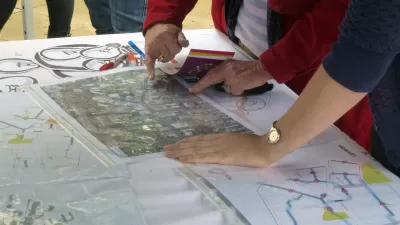
In participatory planning, there is no planning without several events known as charrettes, which you probably already knew. What's not clear, however, is how charrettes can live up to their promise in the planning process.
"Design charrettes are, in theory, a valuable component of the urban planning process that help communities take a little bit of ownership over the changes coming to their streets," according to an article by Josh Cohen.
But there's a but: "In practice, that is often not the case," adds Cohen.
In the hopes of improving this staple of contemporary planning practice, Cohen speaks a collection of expert practitioners of charerretts to gather there thoughts on how improve charettes. Those points, with more detail in the article: 1) Your charrette must be a charrette, 2) Do more and better outreach, 3) Set realistic expectation, 4) Communicate more clearly, and 5) Provide real feedback.
Read the full story: 5 Ways Planners Get Charrettes Wrong

Social Media Bots and the Community Planning Process
Recently published research examines the "Role of Artificial Intelligence in Community Planning"—that is, the role of automated bots on social media in corrupting participatory planning processes.
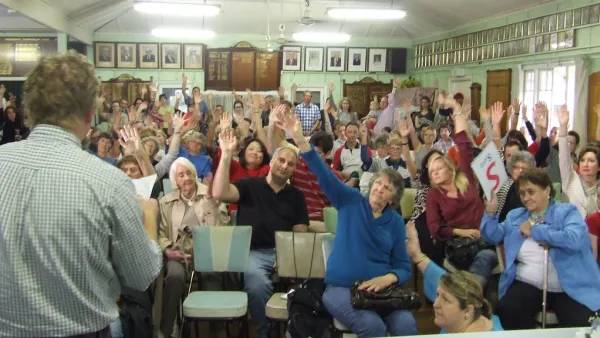
It's Time to Move On From Community Consensus
Public meetings often disprove the notion that communities have a unified stance on any issue. With this in mind, we must move past trying to find consensus and focus on uplifting the most marginalized voices.

Leveraging Social Media for Citizen Engagement in Urban Planning
Discover how urban planners can use social media to enhance citizen engagement, featuring strategies for interactive communication and community involvement in urban development projects.

Planetizen Federal Action Tracker
A weekly monitor of how Trump’s orders and actions are impacting planners and planning in America.

California plans to bury El Niño’s downpour
If the state plays its cards right, it may be able to store a billion acre-feet of El Niño’s water in aquifers.

Desperate measures: Advocates weigh draining Lake Powell to fill Colorado River
Draining the reservoir could reduce evaporation losses by a couple hundred thousand acre-feet.

Mamdani’s pied-à-terre tax survives legal challenge
A panel of judges found that the plaintiffs failed to demonstrate injury as a result of New York City's implementation of the tax.

Eastern Nebraska is running out of electricity
Data centers and electrification are straining eastern Nebraska’s grid, throttling economic development.

Seattle passes record-breaking transit services expansion
Proposition 1 will double the city’s transit tax to add 95,000 more bus trips and preserve 180,000 bus trips annually.

FREE Course: Walkable City 1: Why Walkability?
After describing his path towards focusing on walkability as the essence of good planning, Jeff Speck marches through his five principal reasons for making more walkable places.
Reinventing Malls: Planning Alchemy—Turning Gray Fields Into Gold
The course focuses on the opportunities and imperatives that shape reinvention of mall sites.

City of Rosemead
Rutgers University, Edward J. Bloustein School of Planning and Public Policy
One Hundred Miles
University of Michigan School for Environment and Sustainability (SEAS)
Hunter College, City University of New York (CUNY)
The Architects Foundation
City of Cambridge
Montrose County
The Pocatello Development Authority