As the largest commercial property holder int he United States, the federal government's development plans can contribute to the economic and cultural success of communities.


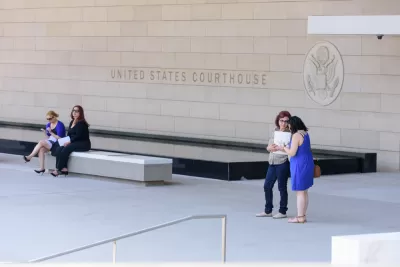
Denise Turner Roth writes:
Towns and cities across the country seek development that promotes vibrant, people-oriented, mixed-use communities. The federal government, which owns significant tracts of land in prime areas for redevelopment, could be a key partner, but genuine collaboration between community leaders and federal officials is essential.
To put a finer point on the term "significant, the U.S. General Services Administration (GSA) is the nation's largest holder of commercial property, according to Turner Roth. Virtually every community in the country has an opportunity to make the most of the federal properties in their midst.
The article provides a collection of case studies of local communities working together with the federal government to redevelop commercial properties. Turner Roth describes examples as varied as Fresno, Boston, and Washington, D.C. On the other side of the equation are cities where a new federal building is proposed. Turner Roth suggests its up to the local community to make sure they integrate their needs with the ambitions of the federal government.
FULL STORY: How Communities Can Unlock the Value of Federal Property

Jersey City could build 700 homes on city-owned parking lots
If approved, a redevelopment proposal would build hundreds of new homes on a pair of city parking lots.
Madison approves hundreds of affordable apartments as deadline for federal funding looms
A recently approved project will bring 163 affordable units to the north side.
LA approves $2B 'urban village' plan for former cold storage facilities
The project promises an interconnected neighborhood with a focus on public space.

Planetizen Federal Action Tracker
A weekly monitor of how Trump’s orders and actions are impacting planners and planning in America.

The state-sanctioned urbicide of Austin
People don’t kill cities. Freeways do.

US to reduce Colorado River water deliveries to Mexico
A new Colorado Treaty amendment reduces Mexico’s Colorado River water allocation by 250,000 acre feet.

Mamdani overhauls NYC's Vision Zero plan with 100 new policy goals
The overhaul aims to reduce traffic deaths and make streets safer for pedestrians, cyclists and drivers through lower speed limits, new safety infrastructure and more.

Amtrak not solely to blame for New Jersey commuter rail's unreliability, report finds
A new study from the Garden State Initiative found that NJ Transit’s budget grew 20% across a 4 year period, but reliability declined significantly over the same period.

EPA erases limits on planet-warming pollution from power plants
Under Monday’s plan, power plants would still have some limits on how much mercury, arsenic and other contaminants they can emit.

FREE Course: Walkable City 1: Why Walkability?
After describing his path towards focusing on walkability as the essence of good planning, Jeff Speck marches through his five principal reasons for making more walkable places.
Reinventing Malls: Planning Alchemy—Turning Gray Fields Into Gold
The course focuses on the opportunities and imperatives that shape reinvention of mall sites.

Eagle County Government
Harvard University Graduate School of Design
Nashville Planning Department
The Architects Foundation
University of Cincinnati Online
The Pocatello Development Authority
The Urban Renewal Agency of the City of Pocatello
Journal of the American Planning Association