Parting shots from the Great American Eclipse.


"The Great American Eclipse has, as expected, turned into the Great American Traffic Snarl," according to an article by Douglas Perry. The proof is in the Google Maps: Perry posts a series of screengrabs to show the long red lines where traffic slowed to a standstill as the eclipse moved across the path of totality yesterday. First congestion came to Western Oregon, and then Eastern Oregon, and then Idaho and Wyoming, and so on.
For a perhaps more awe-inducing view of the eclipse, and maybe to wash the image of all that traffic from your mind, here's satellite imagery from GOES-16, showing the darkness of the eclipse moving across the continent.
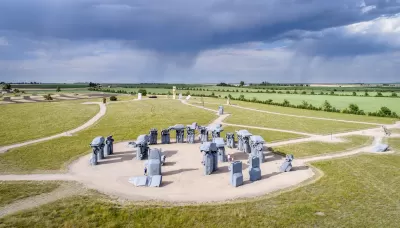
And as one last testament to the power of collective human reaction to the unfathomable scale of nature, we present the story of Carhenge, as detailed in an article by Bart Schaneman. "When Jim Reinders built Carhenge — a Stonehenge replica made out of classic American cars — it was decades before anyone was talking about the path of totality," according to Schaneman. The project was viewed with skepticism in Nebraska, where Carhenge was built, until the it became "one of the most talked-about destinations to view the eclipse in the entire country." It turns out, however, that Reinders never anticipated the Great American Eclipse.
Read the full story: Epic traffic snarls follow 2017 eclipse totality path, Google Maps shows

How People Will See the Eclipse Today
A 33-year GIS professional lets loose his geospatial and population analysis skills on the occasion of a lifetime: today's "Great American Eclipse."
Congestion Costing Reality Check, Part 3: Smart congestion relief
There are many better ways to reduce congestion in your city than expensive roadway expansion projects. Win-win strategies reduce congestion and provide many other benefits.
Congestion Costing Reality Check, Part 2: A congestion costing critique
There are good reasons to be skeptical of highway industry claims that traffic congestion is a growing problem. Their analysis is often incomplete and biased. Let’s pull back the curtain on some major congestion cost studies.

Planetizen Federal Action Tracker
A weekly monitor of how Trump’s orders and actions are impacting planners and planning in America.

California plans to bury El Niño’s downpour
If the state plays its cards right, it may be able to store a billion acre-feet of El Niño’s water in aquifers.

Desperate measures: Advocates weigh draining Lake Powell to fill Colorado River
Draining the reservoir could reduce evaporation losses by a couple hundred thousand acre-feet.

Chicago voters approve permanent festival grounds, penalty for vacant property owners
Currently, major summer and fall festivals take over public parks for weeks at a time, drawing criticism from nearby residents

NYC votes to cut outdoor dining red tape, speed up permitting
New York City also voted to allow the Department of Transportation to begin work on urgent projects before notifying elected officials.

California appears to reject Prop. 45
The proposition would have expanded the projects that qualify for a streamlined environmental review, effectively paring down the California Environmental Quality Act.

FREE Course: Walkable City 1: Why Walkability?
After describing his path towards focusing on walkability as the essence of good planning, Jeff Speck marches through his five principal reasons for making more walkable places.
Reinventing Malls: Planning Alchemy—Turning Gray Fields Into Gold
The course focuses on the opportunities and imperatives that shape reinvention of mall sites.

City of Rosemead
Rutgers University, Edward J. Bloustein School of Planning and Public Policy
One Hundred Miles
Hunter College, City University of New York (CUNY)
The Architects Foundation
University of Cincinnati Online
City of Cambridge
Montrose County
The Pocatello Development Authority