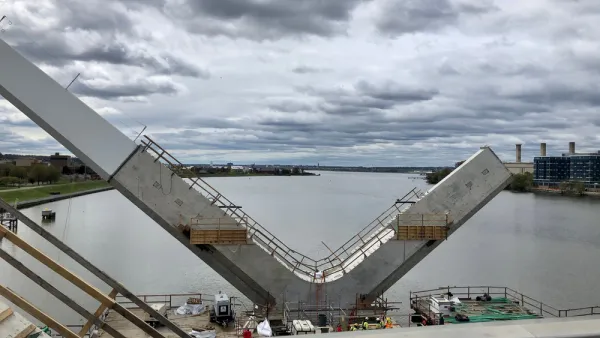
The new Frederick Douglass Memorial Bridge will span the Anacostia River between Washington, D.C. and Anacostia.



Luz Lazo reports:
The District is set to begin its largest construction project in history: replacing the Frederick Douglass Memorial Bridge, which opened in 1950 over the Anacostia River and is one of its busiest commuter gateways, carrying 70,000 vehicles across each day.
D.C. Mayor Muriel E. Bowser revealed the new design [pdf] at an event on Thursday, but city officials on both sides of the river are hoping the bridge spurs economic development.
Lazo provides additional details on the new bridge:
The new, wider bridge will be built parallel to the old one, near Nationals Park. Traffic ovals will be constructed at each end of the bridge, and sections of South Capitol Street will be re-created as a scenic boulevard. The project includes the reconstruction of the interchange with the Suitland Parkway and Interstate 295.
The bridge is scheduled to open in 2021.
Read the full story: D.C. unveils plans for new Frederick Douglass Memorial Bridge. Take a look (video).

Philanthropy Fights Gentrification Around D.C.'s Planned Bridge Park
With lessons from high-profile urban revitalization in place, organizers and philanthropists are working to ensure the 11th Street Bridge Park doesn't push low-income residents out of surrounding neighborhoods.
Working to Ease Gentrification Around D.C.'s Ambitious 11th Street Bridge Project
From the beginning of the proposal for the new 11th Street Bridge between Anacostia and Capitol Hill, planners and designers have promised to prevent the displacement of residents living nearby the new amenities offered by the bridge and its park.
A New Frederick Douglass Memorial Bridge for the Anacostia River in D.C.
The largest infrastructure project in D.C. history is opening this week—first to pedestrians and then to automobile traffic.

Planetizen Federal Action Tracker
A weekly monitor of how Trump’s orders and actions are impacting planners and planning in America.

California plans to bury El Niño’s downpour
If the state plays its cards right, it may be able to store a billion acre-feet of El Niño’s water in aquifers.

Chicago breaks ground on $3 billion megadevelopment
The new neighborhood, titled Foundry Park, will one day host 3,700 residences.

Want to study the Missouri River? Soon, you may need unanimous approval from 10 states
Legislation would require 10 governors’ permission to study or build projects moving water outside the basin.

Desperate measures: Advocates weigh draining Lake Powell to fill Colorado River
Draining the reservoir could reduce evaporation losses by a couple hundred thousand acre-feet.

This road in NYC is infamously dangerous — and Mamdani can't fix it
New York City's Ocean Parkway is known for reckless driving, but the power to implement safety measures lies with the state rather than the city.

FREE Course: Walkable City 1: Why Walkability?
After describing his path towards focusing on walkability as the essence of good planning, Jeff Speck marches through his five principal reasons for making more walkable places.
Reinventing Malls: Planning Alchemy—Turning Gray Fields Into Gold
The course focuses on the opportunities and imperatives that shape reinvention of mall sites.

City of Rosemead
Rutgers University, Edward J. Bloustein School of Planning and Public Policy
One Hundred Miles
Hunter College, City University of New York (CUNY)
The Architects Foundation
University of Cincinnati Online
City of Cambridge
Montrose County
The Pocatello Development Authority