Mayor Bill de Blasio is looking for new ways to fund transit improvements and access.


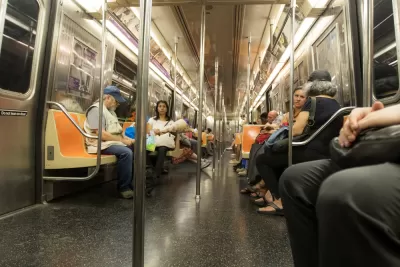
"Mayor Bill de Blasio plans to push for a tax on wealthy New Yorkers to pay for improvements needed to address the crisis engulfing New York City’s subway," reports Emma G. Fitzsimmons.
"Mr. de Blasio will announce a so-called millionaires tax on Monday for wealthy New York City residents to pay for subway and bus upgrades and for reduced fares for more riders, an idea that has been successful in Seattle," adds Fitzsimmons. The new funding would allow low-income riders reduced fares while riding the system. The proposal is modeled on the example of Seattle, which has a similar program that has proven popular, according to the article.
Fitzsimmons describes the move as a salvo in the ongoing political battle between Mayor de Blasio and Governor Andrew Cuomo over the state of transit in and around New York City. Governor Cuomo declared the New York subway system in a "state of emergency" in June, and the Metropolitan Transportation Authority is offering three prizes of $1 million each to the best crowdsourced ideas for fixing the subway.
Read the full story: Bill de Blasio Will Push for Tax on Wealthy to Fix Subway
Breaking News: New York State Ready to Embrace Congestion Pricing, Finally
The New York State Legislature is preparing to reverse over a decade of reluctance regarding congestion pricing, according to reports from Albany.
A Strong Voice of Support for Value Capture to Fund Subway Repair
In an opinion for City & State, Kathryn Wylde, president of the nonprofit Partnership for New York City, makes the case that the Metropolitan Transportation Authority should be allowed to tax properties where value is enhanced by subway proximity.
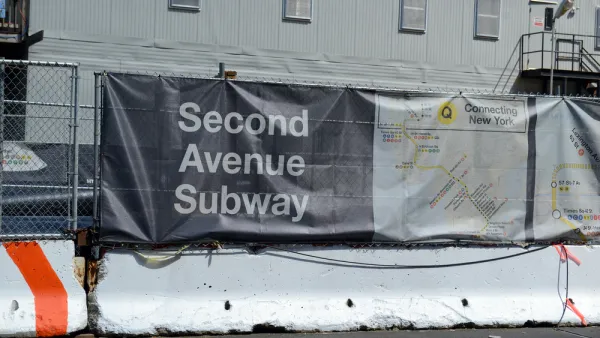
Value Capture Takes Prominent but Controversial Role in Fixing New York Subway
Value capture, collecting tax increment from subway adjacent properties to help provide money needed to repair the 114-year old subway system, is proposed by New York Gov. Andrew Cuomo and opposed by the New York City Mayor Bill de Blasio.

Planetizen Federal Action Tracker
A weekly monitor of how Trump’s orders and actions are impacting planners and planning in America.

Eastern Nebraska is running out of electricity
Data centers and electrification are straining eastern Nebraska’s grid, throttling economic development.

Move over, LA: St. Louis gears up for Olympics, invests millions in downtown redevelopment
The Missouri city will host the 2028 Olympic soccer group stage and knockout matches.

Dallas releases zoning code overhaul to officials
The drafted overhaul is over 400 pages long.

NYC renovations for dangerous, ‘mercilessly crammed’ street delayed until 2027
Construction was supposed to begin this fall.

San Diego’s Midway Rising project gets greenlight from city council
The project looks to become the largest affordable housing development in California's history.

FREE Course: Walkable City 1: Why Walkability?
After describing his path towards focusing on walkability as the essence of good planning, Jeff Speck marches through his five principal reasons for making more walkable places.
Reinventing Malls: Planning Alchemy—Turning Gray Fields Into Gold
The course focuses on the opportunities and imperatives that shape reinvention of mall sites.

City of Rosemead
Rutgers University, Edward J. Bloustein School of Planning and Public Policy
One Hundred Miles
University of Michigan School for Environment and Sustainability (SEAS)
Hunter College, City University of New York (CUNY)
The Architects Foundation
City of Cambridge
The Pocatello Development Authority
The Urban Renewal Agency of the City of Pocatello