Seattle provides plenty of shade for residents to enjoy in the summer months.


Charles Mudede takes a dive into the world of urban tree canopies, comparing Seattle's urban forest to cities around the world and finding that the Pacific Northwest City is pretty green.
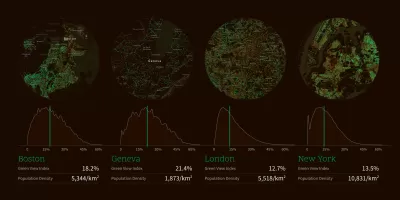
According to Treepedia, the density of Seattle's forest is second only to Sacramento's in the US. Vancouver BC, which is up in Canada and the second-largest city in the Pacific Northwest, has a denser forest than Seattle's.
Mudede also cites a 2012 report called "Forest Ecosystem Values: Analysis of the Structure, Function, and Economic Benefits," to place the number of trees in Seattle at 4.35 trees and tree-like shrubs. That's 7 trees and tree-like shrubs for every resident in Seattle. Mudede also explains the loose definition of "tree" (hence all the "tree-like shrubs")—it might come as a surprise to amateur biologists that there "is no hard science to tree-ness."
Treepedia is also worth another look. The project by the MIT Senseable City Lab uses Google Street View data to measure the urban "Green Canopy," or the aboveground portion of trees and vegetation in cities around the world. Planetizen covered the public release of Treepedia at the beginning of 2017.
Read the full story: Seattle Is the Seventh-Densest City In the World—For Trees
How To Preserve Both Affordable Housing and Urban Trees
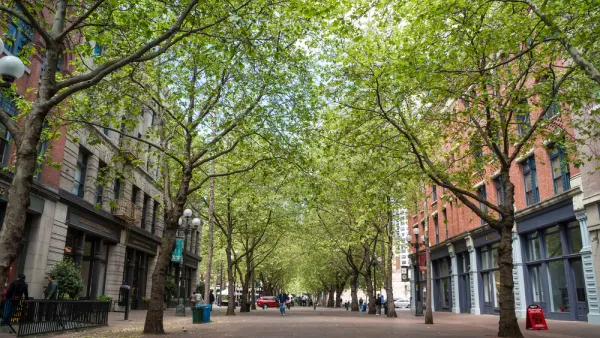
Housing and environmental activists are calling on the city to commit to a ‘Trees and’ approach, rejecting the perceived conflict between housing affordability and a healthy urban tree canopy.
A New Study Asserts the Importance of Urban Trees in Conservation Efforts
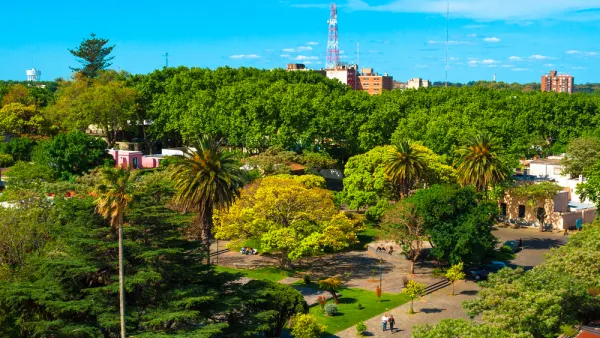
Data collected from 13 million tree planting records in 473 urban areas across 73 countries provides insight into the role of urban trees in biodiversity conservation.
Chicago Was Already Wiping Out Trees. Then the Derecho Hit.
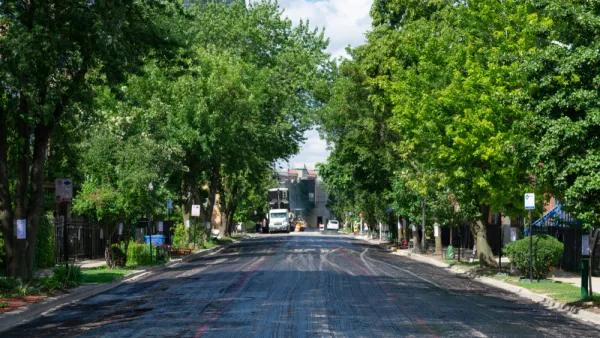
An Urban Forestry Board is needed in Chicago to unsure the health and safety benefits of a flourishing urban forest.

Desperate measures: Advocates weigh draining Lake Powell to fill Colorado River
Draining the reservoir could reduce evaporation losses by a couple hundred thousand acre-feet.

Eastern Nebraska is running out of electricity
Data centers and electrification are straining eastern Nebraska’s grid, throttling economic development.

Malls are becoming the midtowns of the future
Mall and office park redevelopments are a generational opportunity to create new nodes of urbanity.

NYC breaks ground on anti-flooding infrastructure project
New York City's new system will reduce stormwater flows to local sewers by 90%.

One Kentucky town’s secret to affordable housing
The Smoketown Community Land Trust has already built seven affordable homes for community members.

Houston gains petal-shaped cooling infrastructure to make streets more ‘delightful’
The city has installed the pavilions along 15 blocks in Houston.

FREE Course: Walkable City 1: Why Walkability?
After describing his path towards focusing on walkability as the essence of good planning, Jeff Speck marches through his five principal reasons for making more walkable places.
Reinventing Malls: Planning Alchemy—Turning Gray Fields Into Gold
The course focuses on the opportunities and imperatives that shape reinvention of mall sites.

City of Rosemead
Rutgers University, Edward J. Bloustein School of Planning and Public Policy
One Hundred Miles
University of Michigan School for Environment and Sustainability (SEAS)
Hunter College, City University of New York (CUNY)
The Architects Foundation
City of Cambridge
Montrose County
The Pocatello Development Authority