More than 20 percent of New York's smaller music venues have closed in the past 15 years. Although Brooklyn institution Barbes was recently saved by a crowdfunding campaign, its founder is pessimistic about the future of New York's independent arts.


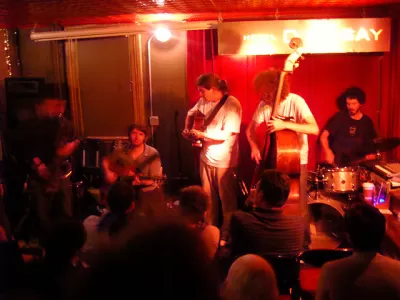
A recent report commissioned by New York's Mayor's Office of Media and Entertainment (MOME) is generally bullish about the city's music business, but identifies fault lines exactly where you might expect. The segment of the industry the authors identify as "mass music consumption"—a category that involves major live performances, broadcasting, online streaming, and record sales—is booming, with high average salaries and an expanding number of jobs. At the other end of the industry, a group identified as "local artist communities"—which includes the actual musicians, along with small venues like Barbes, schools, and rehearsal spaces—is struggling.
"I'm pretty pessimistic," Barbes founder Olivier Conan said. "I think we're going through such a horribly brutal phase of... I don't know, economic oppression, almost; I don't know what you call it. Since cities have become desirable again, there's no safe place for you to create low-cost environments that foster art."
Read the full story: Safe for now, Brooklyn music venue Barbès sees a cloudy future
Brooklyn’s Great Gentrification Divide
Joseph Berger examines how gentrification in certain Brooklyn neighborhoods has revealed a conflict of values among residents.
Friday Funny: Gentrification, Coming to a Neighborhood Near You
A series of mock-advertisements herald the gentrification of Brooklyn.
Great Album Covers with Urban Planning Themes
Album covers that evoke urban themes.

Planetizen Federal Action Tracker
A weekly monitor of how Trump’s orders and actions are impacting planners and planning in America.

California plans to bury El Niño’s downpour
If the state plays its cards right, it may be able to store a billion acre-feet of El Niño’s water in aquifers.

Desperate measures: Advocates weigh draining Lake Powell to fill Colorado River
Draining the reservoir could reduce evaporation losses by a couple hundred thousand acre-feet.

Chicago voters approve permanent festival grounds, penalty for vacant property owners
Currently, major summer and fall festivals take over public parks for weeks at a time, drawing criticism from nearby residents

NYC votes to cut outdoor dining red tape, speed up permitting
New York City also voted to allow the Department of Transportation to begin work on urgent projects before notifying elected officials.

California appears to reject Prop. 45
The proposition would have expanded the projects that qualify for a streamlined environmental review, effectively paring down the California Environmental Quality Act.

FREE Course: Walkable City 1: Why Walkability?
After describing his path towards focusing on walkability as the essence of good planning, Jeff Speck marches through his five principal reasons for making more walkable places.
Reinventing Malls: Planning Alchemy—Turning Gray Fields Into Gold
The course focuses on the opportunities and imperatives that shape reinvention of mall sites.

City of Rosemead
Rutgers University, Edward J. Bloustein School of Planning and Public Policy
One Hundred Miles
Hunter College, City University of New York (CUNY)
The Architects Foundation
University of Cincinnati Online
City of Cambridge
Montrose County
The Pocatello Development Authority