Planning for resilience might mean more than preparing for climate change, according to this opinion piece. Urban terrorism, in its current, tragic form, will require planners to prepare for the worst.


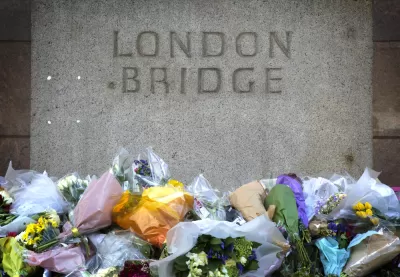
Jon Coaffee, a professor of urban geography in the Department of Politics and International Studies at the University of Warwick, takes to the pages of The Washington Post to make an appeal for planners to prepare for "a new onslaught of urban terrorism."
"State security services have long been occupied with defending vulnerable urban spaces against attack," writes Coafee, "but until recently, the style of terrorist attack — the targeting of high-profile commercial or government buildings — seldom affected everyday city life." But a recent string of terrorist attacks in Europe has relied on relatively low-tech devices like trucks and knives.
According to Coafee, "the modus operandi of terrorists has changed significantly in recent years and counter-responses, including urban planning, must adapt to this new reality."
The idea of preparing for the perpetual threat of terrorism is a challenging proposition at best. It's impossible, according to Coafee,"to perfectly balance urban aesthetics and livability within secure design, just as it’s impossible to prevent every kind of attack in any open society." Still, he writes, measures can be taken.
Planetizen correspondent Irvin Dawid has noted some of the public safety infrastructure that works to deter terrorism, such as sidewalk bollards. In the past, anti-terrorism planning has also focused on transit and drinking water supplies.
Read the full story: Urban terrorism isn’t going to stop. Can city planners help reduce its lethal impact?

The Top Urban Planning Books of 2022
An annual list of the must-read books related to urban planning and its intersecting fields.
'Intersections + Identities: A Radical Rethinking of Our Transportation Experiences'
The American Planning Association's free "State of Transportation Planning Report" includes more than two dozen interesting and entertaining chapters by diverse authors on the subjects of planning resilience, equity, technology and mobility.
Fairfax County, Virginia Releases Climate Adaptation Plan
Fairfax County, Virginia estimates that climate change caused $25 million in damages from 2010 to 2019. A new plan is meant to prevent worse losses in the years and decades to come.

Planetizen Federal Action Tracker
A weekly monitor of how Trump’s orders and actions are impacting planners and planning in America.

Washington state to charge fee to drivers with fuel-efficient cars
Revenue from the fee will go towards supporting the state’s highways.

Illinois considers spending $1 billion in taxpayer money on data center
A quantum computing campus and data center are currently under construction in Chicago.

Did data centers change how voters cast their ballots?
Texas, Ohio, and Georgia all flipped party control. But in rural counties, the effect of local data centers was mixed.

Amtrak invests in eight new Airo trainsets
The new trainsets will begin serving passengers in 2031.

HUD to end aid for mixed-immigration-status households
The new rule is projected to impact 80,000 people, nearly half of whom are children.

FREE Course: Walkable City 1: Why Walkability?
After describing his path towards focusing on walkability as the essence of good planning, Jeff Speck marches through his five principal reasons for making more walkable places.
Reinventing Malls: Planning Alchemy—Turning Gray Fields Into Gold
The course focuses on the opportunities and imperatives that shape reinvention of mall sites.

City of Charlotte
City of Rosemead
Rutgers University, Edward J. Bloustein School of Planning and Public Policy
University of Michigan School for Environment and Sustainability (SEAS)
Hunter College, City University of New York (CUNY)
The Architects Foundation
University District Partnership