Matthew Desmond's ethnographic study has received critical praise. But David Adler asks whether the book's approach tacitly lets affluent non-landlords off the hook.


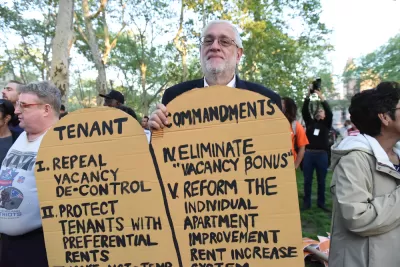
Matthew Desmond's Pulitzer-winning Evicted looks as America's housing crisis through the eyes of its underdogs: tenants at the mercy of profiteering landlords. While publicizing those perspectives is important, David Adler gets the sense that "most readers feel that the Desmond's evictions are distant from them — something they merely observe as sympathetic spectators, rather than something in which all of us actively participate."
Adler doubts whether housing vouchers could really achieve much in tight speculative markets. "The deceptive simplicity of Desmond's policy prescription—housing vouchers—implies that an inclusive housing system can be accomplished in one fell swoop, without any substantial sacrifices or lifestyle change on the part of the privileged."
"This is the piece that is missing from Desmond's Evicted: housing markets are broadly zero-sum. Accumulation for some is immiseration for others. We are all tied together — landlords and tenants, homeowners and homeless." A truly inclusive housing situation, Adler suggests, may not be possible under the traditional conception of a "market."
Read the full story: Who Profits From Poverty?


Section 8 Not Welcome
More landlords are refusing Section 8 vouchers for housing, neither willing to deal with the federal bureaucracy nor to risk missing out on the peak windfall of an expansive rental market.

Evicted's Stories of Housing and Poverty Earn the Pulitzer Prize
Housing experts have been reading and passing around "Evicted," by Matthew Desmond, since its release last year. Now the book has won the Pulitzer Prize for general nonfiction.

Federal cuts to voucher program put 9,000 New Yorkers at risk of homelessness
The Emergency Housing Voucher program is ending years ahead of schedule, forcing housing agencies to find new ways to support roughly 70,000 households nationwide.

Planetizen Federal Action Tracker
A weekly monitor of how Trump’s orders and actions are impacting planners and planning in America.

Amtrak, CN end decades-long dispute with eight-year agreement
The new operating agreement establishes an updated framework for the companies to work together, including processes to resolve disputes.

Northwest rail fans eager for Sept. 30 debut of Amtrak’s Airo fleet
Get ready for that new train smell and more seats. But they won’t go faster or run more frequently on the Cascades route in Washington and Oregon.

Brightline Florida files for bankruptcy
The transit company is over $5 billion in debt.

St. Louis Metro to test if single-car trains can reduce operating costs, maintain rider satisfaction
The pilot program will run from October to spring 2027, and begin with one single-car train operating on Metrolink’s Red and Blue lines.

Pennsylvania is building data centers in abandoned mines
Housing data centers in mines provides an alternative to destroying local forests and may spare residents from data centers’ noise and air pollution.

FREE Course: Walkable City 1: Why Walkability?
After describing his path towards focusing on walkability as the essence of good planning, Jeff Speck marches through his five principal reasons for making more walkable places.
Reinventing Malls: Planning Alchemy—Turning Gray Fields Into Gold
The course focuses on the opportunities and imperatives that shape reinvention of mall sites.

City of Thousand Oaks
City of Wisconsin Rapids
Harvard University Graduate School of Design
The Architects Foundation
University of Cincinnati Online
The Pocatello Development Authority
The Urban Renewal Agency of the City of Pocatello