There was a tiny bit of cuteness to emerge from the news in Washington, D.C. this week. Partisan bickering soon followed.


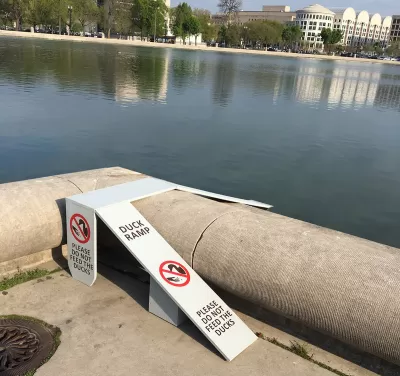
Joanne Pierce broke the news yesterday on a headline-grabbing new infrastructure project recently completed in Washington, D.C.: the installation of new ramps to help ducks in and out of the Capitol Reflecting Pool at Union Square.
"The duck ramps are painted in bright white and easily noticeable. They also say, 'Duck Ramp' on them, so humans and ducks alike know who should use the ramps. No word on whether pigeons and squirrels are offended," writes Pierce with the appropriate amount of tongue-in-cheek to explain the development.
An article by Liam Stack takes the snark a step further—pretending for a moment that the story is evidence of another Trump Administration scandal. After revealing the real nature of the story ("This is a story about ducks."), Stack puts the spotlight on Representative Mark Walker, Republican of North Carolina, who took to Twitter earlier this week to say the ramps are examples of government waste.
If it looks like a duck and walks like a duck, it must be government waste. pic.twitter.com/JKgabZ47O5
— Rep. Mark Walker (@RepMarkWalker) May 15, 2017
Meanwhile, the Architect of the Capitol, which installed the ramps, tweeted a video that showed ducklings using the ramp. Stack includes a series of responses to Rep. Walker's take on the ramps.
Capitol Reflecting Pool has been a popular attraction—for ducks +humans! NEW: 2 ramps to safely assist ducks in/out: https://t.co/IRHGHmwQ5T pic.twitter.com/bPFWQsMXAW
— U.S. Capitol (@uscapitol) May 15, 2017
There was also more than one person on Twitter linking the duck ramps to the Trump Administration's long-promised, expected-soon, $1 trillion infrastructure plan.
So far the only effective Federal infrastructure project of Trump's term: https://t.co/mSJBnLUYIh
— Michael Shapiro (@mpshapiro) May 16, 2017
Read the full story: New ramps help ducks in and out of the Capitol Reflecting Pool

When California Mountain Lions Become City Dwellers
As urban sprawl continues to encroach on what was once expansive habitat for mountain lions, the large predators have been involved in more encounters with humans in urban settings.

From robotaxis to robotrains: LA, DC weigh driverless transit
If approved, the projects will take years to implement and face financial and technical hurdles.

Are cities at risk of losing squirrels?
Book review: A common backyard forager could be in decline, but without the proper data we may not know until it’s too late. Nancy Castaldo’s "Squirrel" urges us to find out.

Planetizen Federal Action Tracker
A weekly monitor of how Trump’s orders and actions are impacting planners and planning in America.

California plans to bury El Niño’s downpour
If the state plays its cards right, it may be able to store a billion acre-feet of El Niño’s water in aquifers.

Desperate measures: Advocates weigh draining Lake Powell to fill Colorado River
Draining the reservoir could reduce evaporation losses by a couple hundred thousand acre-feet.

How a Chicago-sized wind farm beat the odds and powered on
The project spanned five presidential administrations and a standoff with a U.S. military base.

MTA gives itself 30 days to transform pit into basketball court
The site has been under construction since 2022; the city originally estimated it would finish the court in 2024.

Non-stop party: Chicago voters weigh permanent festival grounds
A stable place for bleachers, stages and drainage may streamline the setup and teardown of large events.

FREE Course: Walkable City 1: Why Walkability?
After describing his path towards focusing on walkability as the essence of good planning, Jeff Speck marches through his five principal reasons for making more walkable places.
Reinventing Malls: Planning Alchemy—Turning Gray Fields Into Gold
The course focuses on the opportunities and imperatives that shape reinvention of mall sites.

City of Rosemead
Rutgers University, Edward J. Bloustein School of Planning and Public Policy
One Hundred Miles
Hunter College, City University of New York (CUNY)
The Architects Foundation
University of Cincinnati Online
City of Cambridge
Montrose County
The Pocatello Development Authority