Can a few splashes of water on hot pavement reduce the heat island effect? Researchers find evidence to support a traditional Japanese method of cooling the environment.


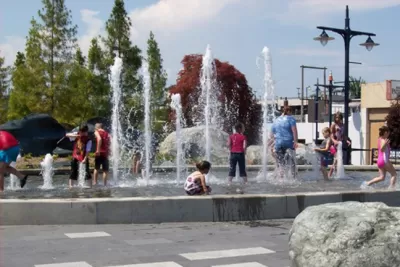
Researchers from Delft University of Technology in the Netherlands have made a positive connection between the traditional Japanese practice of sprinkling water on the ground and the reduction in ground and air temperature. Samuel Illingworth of The Poetry of Science writes that the research, presented at the European Geosciences Union General Assembly in April, showed a decreased surface and air temperature in a controlled three dimensional area, as measured by fiber optic cables.
Uchimizu involves the sprinkling of water over an area of land (uchi comes from the Japanese verb utsu meaning to hit or strike, and mizu is the Japanese word for water), and it is traditionally performed using a bucket and ladle whilst wearing a yukata.
The findings suggest that the act of uchimizu could help to mitigate the heat island effect in high temperature areas with low permeability.
Read the full story: Ancient Cooling

Twin Cities Climate Vulnerability: Extreme Heat
State climatologists are highly confident that heat waves are likely to trend upwards in future summers in Minnesota. To address extreme heat, researchers are identifying the factors that exacerbate extreme heat.

How Can Cities Adapt to Rising Temperatures? Change the Weather
Brian Stone of the Georgia Institute of Technology writes about a recent article he co-authored in the Journal of Planning Education and Research.
How to Beat Extreme Heat
Louisville, Kentucky has recently been named the "most rapidly growing urban heat island" in the U.S., but what led to this title? Jeff Byles traces how cities are becoming increasingly warm through a number of different factors, including economic.

Planetizen Federal Action Tracker
A weekly monitor of how Trump’s orders and actions are impacting planners and planning in America.

Amtrak, CN end decades-long dispute with eight-year agreement
The new operating agreement establishes an updated framework for the companies to work together, including processes to resolve disputes.

Northwest rail fans eager for Sept. 30 debut of Amtrak’s Airo fleet
Get ready for that new train smell and more seats. But they won’t go faster or run more frequently on the Cascades route in Washington and Oregon.

Brightline Florida files for bankruptcy
The transit company is over $5 billion in debt.

St. Louis Metro to test if single-car trains can reduce operating costs, maintain rider satisfaction
The pilot program will run from October to spring 2027, and begin with one single-car train operating on Metrolink’s Red and Blue lines.

Pennsylvania is building data centers in abandoned mines
Housing data centers in mines provides an alternative to destroying local forests and may spare residents from data centers’ noise and air pollution.

FREE Course: Walkable City 1: Why Walkability?
After describing his path towards focusing on walkability as the essence of good planning, Jeff Speck marches through his five principal reasons for making more walkable places.
Reinventing Malls: Planning Alchemy—Turning Gray Fields Into Gold
The course focuses on the opportunities and imperatives that shape reinvention of mall sites.

City of Thousand Oaks
City of Wisconsin Rapids
Harvard University Graduate School of Design
The Architects Foundation
University of Cincinnati Online
The Pocatello Development Authority
The Urban Renewal Agency of the City of Pocatello