If companies like Startship and Marble get their way, sidewalks will play host to hundreds of rolling delivery bots. It's one solution to "last-mile" logistics, but are pedestrians prepared to give way?


The concept of airborne delivery drones has been floating around for a while now. Julia Carrie Wong writes, "Amazon, UPS and Google are all working on an airborne method, which certainly makes for splashy PR stunts. But in cities, ground-based delivery services are a more practical solution."
Underutilized sidewalks could be great highways for delivery robots, but the concept has its detractors. "'If there really were hundreds of little robots,' [University of New Mexico professor] Renia Ehrenfeucht said, 'they would stop functioning as sidewalks and start functioning more as bike lanes. They would stop being spaces that are available for playing games or sitting down.'"
According to the executive director of Walk San Francisco, "People live in urban centers not because they want to sit at home in their house and have their toothbrush delivered to their door, but because they have a pharmacy around the corner that they can walk to."
Once regulation becomes an issue, the robots might have already taken over. "But it will likely take longer for city dwellers to notice the impact of delivery robots on their day to day lives, said Ehrenfeucht, who said that regulation will likely only come after widespread adoption, as it did with other disruptive technologies such as Uber and Airbnb."
Read the full story: Delivery robots: a revolutionary step or sidewalk-clogging nightmare?
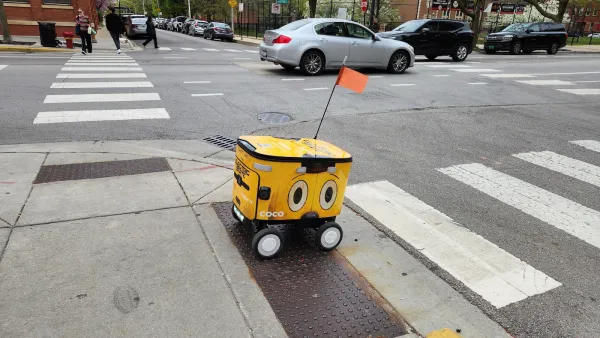
West Hollywood makes delivery robots paying road users
Cities are looking for creative ways to regulate food delivery robots, in some cases putting them to work gathering data for ADA compliance or collecting revenue for sidewalk maintenance.
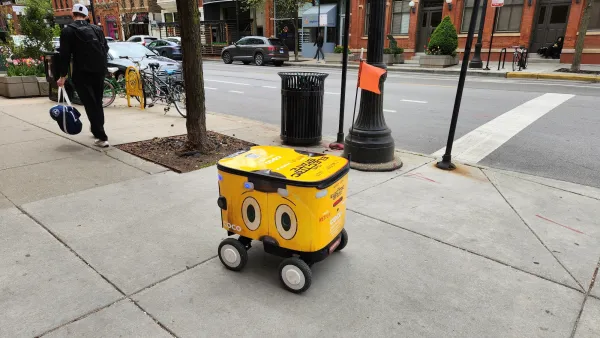
Delivery Robots are Taking Over Chicago Sidewalks, Alarming Residents
Residents have reported that the food delivery bots have forced people off sidewalks into busy streets and collided with bicyclists.
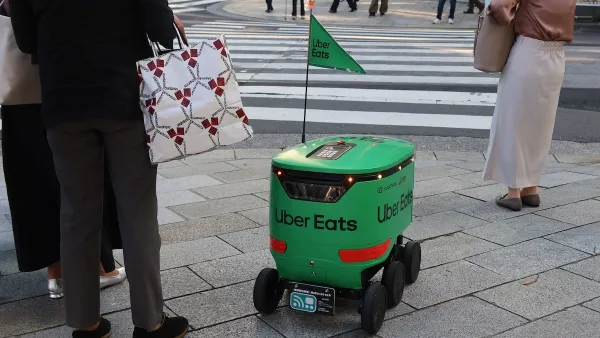
Opinion: Delivery Robots Need Regulation Now
Ride-hailing and scooter companies blindsided cities. They shouldn’t let delivery robots do the same.

Planetizen Federal Action Tracker
A weekly monitor of how Trump’s orders and actions are impacting planners and planning in America.

Washington state to charge fee to drivers with fuel-efficient cars
Revenue from the fee will go towards supporting the state’s highways.

Trump to blast ‘hydrocarbon highway’ through ‘world’s longest art gallery’
Environmental and historic preservation groups are suing to stop the project.

MBTA Green Line project moved to next phrase of CIG program
The modernization effort will cost $4.08 billion.

22-mile pedestrian and bike path to encircle Atlanta by 2030
The project will also support affordable housing.

Army detonates nearly 5 tons of lead in Iowa
The detonation comes after days of delays and public outcry.

FREE Course: Walkable City 1: Why Walkability?
After describing his path towards focusing on walkability as the essence of good planning, Jeff Speck marches through his five principal reasons for making more walkable places.
Reinventing Malls: Planning Alchemy—Turning Gray Fields Into Gold
The course focuses on the opportunities and imperatives that shape reinvention of mall sites.

City of Charlotte
City of Rosemead
Rutgers University, Edward J. Bloustein School of Planning and Public Policy
University of Michigan School for Environment and Sustainability (SEAS)
Hunter College, City University of New York (CUNY)
The Architects Foundation
University District Partnership