The team at Strong Towns is taking an in-depth look at Amazon, with a week of events, including the point-counterpoint series shared here.


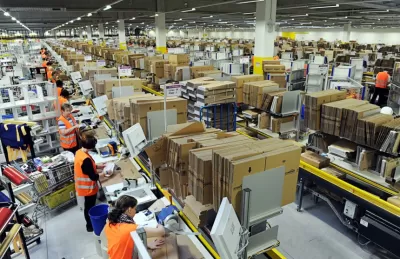
Kea Wilson writes an entreaty for planners and others concerned about the built environment to devote more considerations to the impacts of the growing popularity of online retailer Amazon.
Wilson begins the article by acknowledging the considerable time and energy devoted to critiquing the negative externalities of big box stores. Wilson's appeal to the audience: Amazon could be just as detrimental to the built environment as big box retail has been.
Wilson then lists a few reasons for skepticism toward a future of Amazon-enabled retail, such as Amazon's effect for property and sales tax revenues, Amazon's track record of eliminating jobs, and the casualties in Main Street businesses that will join the loss of larger, national brands.
Responding to the request to focus on Amazon, Charles Marohn has already penned a response. Marohn disagrees with Wilson, first by saying he doesn't dislike Walmart, and then by arguing that the "Amazon benefit" won't last. His larger point is that companies like Walmart and Amazon are taking advantage of a bad game with bad rules. "If you don't like the game, change the rules," writes Marohn, referencing earlier Strong Towns coverage of big box stores.
Read the full story: Why Urbanists Need to Talk About Amazon

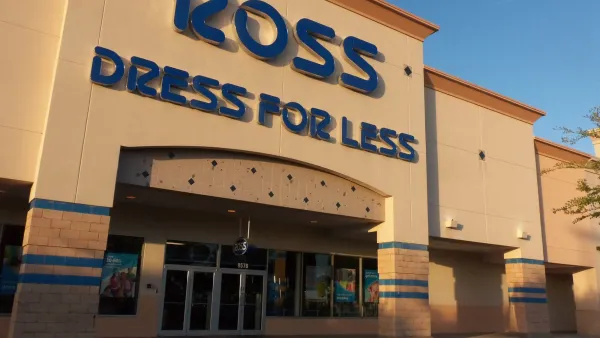
Ross May Be Immune from the Amazon Effect
Ross Stores continues its expansion in the face of a much-foretold retail apocalypse. The shopping experience it provides may be one reason it can stand up to Amazon.
Envisioning a Future Urban Dronescape
Jeff Bezos' proposal to deliver packages by aerial drone has the potential to upset traditional models of logistics and distribution, but it's most powerful effect may be on the urban airspace. Are blue skies ahead for Bezos' vision?

Planetizen Federal Action Tracker
A weekly monitor of how Trump’s orders and actions are impacting planners and planning in America.

Amtrak, CN end decades-long dispute with eight-year agreement
The new operating agreement establishes an updated framework for the companies to work together, including processes to resolve disputes.

Northwest rail fans eager for Sept. 30 debut of Amtrak’s Airo fleet
Get ready for that new train smell and more seats. But they won’t go faster or run more frequently on the Cascades route in Washington and Oregon.

St. Louis Metro to test if single-car trains can reduce operating costs, maintain rider satisfaction
The pilot program will run from October to spring 2027, and begin with one single-car train operating on Metrolink’s Red and Blue lines.

Pennsylvania is building data centers in abandoned mines
Housing data centers in mines provides an alternative to destroying local forests and may spare residents from data centers’ noise and air pollution.

If Corpus Christi can’t revive desalination plant project, it may owe Texas $235 million
Earlier this month, city officials declined to pursue developing the plant for the second time in a year.

FREE Course: Walkable City 1: Why Walkability?
After describing his path towards focusing on walkability as the essence of good planning, Jeff Speck marches through his five principal reasons for making more walkable places.
Reinventing Malls: Planning Alchemy—Turning Gray Fields Into Gold
The course focuses on the opportunities and imperatives that shape reinvention of mall sites.

City of Thousand Oaks
City of Wisconsin Rapids
Harvard University Graduate School of Design
The Architects Foundation
University of Cincinnati Online
The Pocatello Development Authority
The Urban Renewal Agency of the City of Pocatello