President Trump may be stuck in a past era of thriving coal mines, but at least one forward-thinking coal company sees lucrative opportunities in using reclaimed mountaintop strip mines as sites for solar farms.



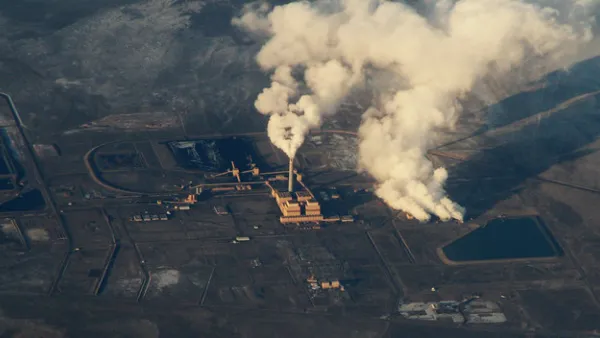
A plan has been proposed by an Eastern Kentucky coal mining company and a renewable energy group to build a solar farm on the site of a reclaimed mountaintop strip mine (such as this image), reports James Bruggers for the Courier-Journal. In addition to selling the solar power to utilities that are required to meet minimum thresholds of generation from renewable sources, the partnership presents an opportunity to employ displaced coal miners.
The Berkeley Energy Group [unable to locate link] and EDF Renewable Energy, a subsidiary of Paris-based EDF Energies Nouvelles] are exploring what they're billing as the first large-scale solar project in Appalachia. They're focused on two mountaintop-removal mining sites outside Pikeville [county seat of Pike County, Kentucky], where engineering and feasibility studies are underway for a 50- to 100-megawatt project.
"I grew up with coal," said Ryan Johns, an executive with Berkeley, an Eastern Kentucky coal company. "Our company has been in the coal business for 30 years. We are not looking at this as trying to replace coal, but we have already extracted the coal from this area."
In addition to the two energy companies, Edelen Strategic Ventures, a Kentucky-based management consultancy started by former Kentucky Auditor Adam Edelen, is behind the idea of providing a second energy-extraction life for the mountaintop strip mines.
Edelen said that he and John's of Berkeley Energy have "had no trouble generating interest in the project because of its powerful narrative of employing displaced coal miners on mined-over land and creating a partnership between a coal company and another that's focused on renewable energy."
Bruggers, whose specialty is environment, environmental health, energy and science, details the drop in coal extraction and mining employment since 2008 do largely to competition from cheaper natural gas. However, that cleaner-burning fossil fuel is now facing competition due to states that adopted renewable portfolio standards that require utilities to produce a minimum amount of electrical generation from renewable sources
"The project would connect to the electricity grid through a regional transmission organization called PJM, which includes several states — Ohio, Pennsylvania and New Jersey — that require utilities to offer a certain amount of electricity from renewable sources, including solar and wind," reports Bill Estep for the Lexington Herald-Leader.
The partners have started the process of accessing the PJM grid, but the project isn’t set in stone.
Putting solar panels on a reclaimed mine is a different engineering challenge. Some mined sites have needed significant work to compact the soil before construction.
Estep adds that studies will continue through the year to determine the economic and engineering feasibility of the project.
Hat tip to Loren Spiekerman.
Read the full story: Coal company plans huge solar farm on strip mine


Solar Farm Moratorium to End, Despite Local Concerns
Delaware County plans to amend its solar zoning ordinance and lift a moratorium on the construction of new solar farms that was implemented after local opposition stalled the project.

Delaware County Pauses Solar Applications In Response to Local Opposition
Large-scale solar developments face rising hostility from neighboring property owners who cite concerns about environmental degradation, reduced property values, and loss of farmland.
Shuttering a Large Coal Plant: A Tale of Two States
Environmentalists in California are upset that Los Angeles will build a new 840-megawatt natural gas plant to replace a 1,800-megawatt coal plant. The coal plant has been crucial to the economic development of Millard County, Utah.

Planetizen Federal Action Tracker
A weekly monitor of how Trump’s orders and actions are impacting planners and planning in America.

California plans to bury El Niño’s downpour
If the state plays its cards right, it may be able to store a billion acre-feet of El Niño’s water in aquifers.

Chicago breaks ground on $3 billion megadevelopment
The new neighborhood, titled Foundry Park, will one day host 3,700 residences.

California High-Speed Rail Authority CEO resigns after $600,000 scandal
Under Ian Choudri, the authority used taxpayer dollars to fund first class flights and trips to nightclubs.

Want to study the Missouri River? Soon, you may need unanimous approval from 10 states
Legislation would require 10 governors’ permission to study or build projects moving water outside the basin.

Desperate measures: Advocates weigh draining Lake Powell to fill Colorado River
Draining the reservoir could reduce evaporation losses by a couple hundred thousand acre-feet.

FREE Course: Walkable City 1: Why Walkability?
After describing his path towards focusing on walkability as the essence of good planning, Jeff Speck marches through his five principal reasons for making more walkable places.
Reinventing Malls: Planning Alchemy—Turning Gray Fields Into Gold
The course focuses on the opportunities and imperatives that shape reinvention of mall sites.

City of Rosemead
Rutgers University, Edward J. Bloustein School of Planning and Public Policy
One Hundred Miles
Hunter College, City University of New York (CUNY)
The Architects Foundation
University of Cincinnati Online
City of Cambridge
Montrose County
The Pocatello Development Authority