The transportation network company is facing an ongoing legal battle over its drivers’ right to unionize in Seattle and an antitrust lawsuit in New York.


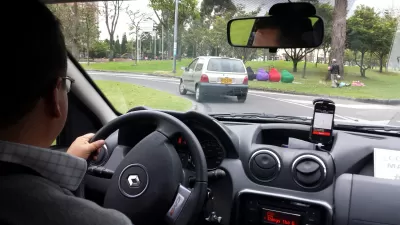
Seattle Uber drivers will not be allowed to unionize yet, but the legal battle between the city and the transportation network company continues. "A federal judge put an indefinite hold on a Seattle ordinance that gives for-hire drivers used by Uber, Lyft, and other ride-sharing apps the right to vote to unionize for collective bargaining, even though those drivers are categorized as independent contractors and not traditional employees," Jack Denton writes for Pacific Standard. The freeze is likely to stay in place until the conclusion of an antitrust lawsuit in front of the Chamber of Commerce. The city of Seattle could also appeal the judge's decision.
Meanwhile in New York, "Uber is facing a separate federal antitrust suit," Denton writes. This lawsuit alleges that as private contractors, Uber's drivers are being forced to fix prices by the company. The southern district of New York argues, "If Uber is merely selling an app that allows independent drivers to find customers, then it is a violation of the Sherman Act — price-fixing — for Uber and its drivers to implicitly conspire to charge certain prices."
Read the full story: Two Federal Lawsuits Could Spell Big Trouble for Uber

Uber Files Lawsuit Against Seattle Over Unionization
Uber kicks off its 'Year of the Driver' by suing the city of Seattle for allowing its drivers to unionize.
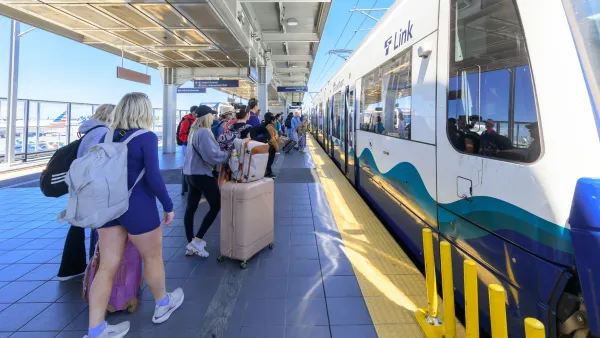
How Chicago, New York and Seattle are funding transit projects amid tough times
Notes from the American Public Transportation Association's TransForm conference in Chicago.
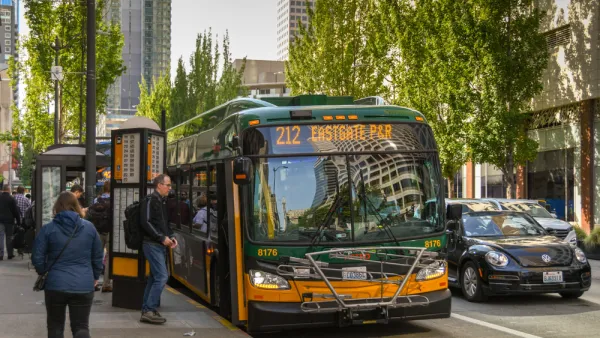
Seattle Transit Winning Back Riders Faster Than Ridehailing
Ridehailing companies saw a steep drop in ridership in the city during the pandemic, followed by a slow recovery as their prices increase and demand slows.

Planetizen Federal Action Tracker
A weekly monitor of how Trump’s orders and actions are impacting planners and planning in America.

California plans to bury El Niño’s downpour
If the state plays its cards right, it may be able to store a billion acre-feet of El Niño’s water in aquifers.

Desperate measures: Advocates weigh draining Lake Powell to fill Colorado River
Draining the reservoir could reduce evaporation losses by a couple hundred thousand acre-feet.

Mamdani’s pied-à-terre tax survives legal challenge
A panel of judges found that the plaintiffs failed to demonstrate injury as a result of New York City's implementation of the tax.

Eastern Nebraska is running out of electricity
Data centers and electrification are straining eastern Nebraska’s grid, throttling economic development.

Seattle passes record-breaking transit services expansion
Proposition 1 will double the city’s transit tax to add 95,000 more bus trips and preserve 180,000 bus trips annually.

FREE Course: Walkable City 1: Why Walkability?
After describing his path towards focusing on walkability as the essence of good planning, Jeff Speck marches through his five principal reasons for making more walkable places.
Reinventing Malls: Planning Alchemy—Turning Gray Fields Into Gold
The course focuses on the opportunities and imperatives that shape reinvention of mall sites.


City of Rosemead
Rutgers University, Edward J. Bloustein School of Planning and Public Policy
One Hundred Miles
University of Michigan School for Environment and Sustainability (SEAS)
Hunter College, City University of New York (CUNY)
The Architects Foundation
City of Cambridge
Montrose County
The Pocatello Development Authority