Making movies has a lot in common with developing real estate: producers = developers; screenwriters = architects; directors = general contractors. The similarities are more than trivial. Both industries are now hurting in L.A.



In a piece in the California Planning & Development Report, Josh Stephens makes the case that the decline of the Los Angeles film industry — “with 31% fewer filming days in 2024 compared to 2020” — is tied up with the city’s housing crisis.
"Fundamentally, entertainment and real estate must predict the future. Projects evolve on the order of years. They are capital-intensive, demanding up-front monies years before revenues come in, depending on the whims of consumers. Some projects appeal to urban aesthetes; others are family-friendly. Ultimately, audiences file into the theater or turn on the TV, inhabiting a fantasy for a little while. Residents and tenants move in, acting out their lives for months, years, or forever."
The loss of filming has significant ripple effects for the local economy. “Craftspeople are out of work. Support services like prop shops are closing. CBS recently sold Television City, its West Coast headquarters, which will be redeveloped. At least one entire studio lot -- the historic 20th Century Fox lot, now owned by Disney -- may be vacated, left to an uncertain fate.”
Meanwhile, housing remains unaffordable for many Angelenos. According to UCLA research, “Though Los Angeles recently adopted a massive housing-oriented rezoning program, called CHIPS, ‘Los Angeles will fall far short of its housing production goal’ and will risk ‘displacement of vulnerable households’ unless it supplements the rezoning with an ‘ambitious single-family upzoning policy.’”
Stephens concludes that “Hollywood needs to wake up. The need for housing -- via apartments, ADU's, transit-oriented development -- needs to go viral. Ideally, Hollywood should promote exactly the type of neighborhoods that it likes to shoot. Movies and TV shows disproportionately portray busy, walkable, attractive urban neighborhoods (see related CP&DR commentary) that are easy to create on a studio lot but almost impossible with conventional zoning, financing, and infrastructure. This is the moment when both of these once-great industries, with help from planners, need to recognize their common interests and flip this script.”
Read the full story: Why Hollywood and the Housing Industry Need Each Other


L.A.'s Anti-Density Advocate Still Hopes to Make Planners 'Uncomfortable'
One of the main forces behind Measure S spills her thoughts on Hollywood, homelessness and what’s wrong with planning in Los Angeles.
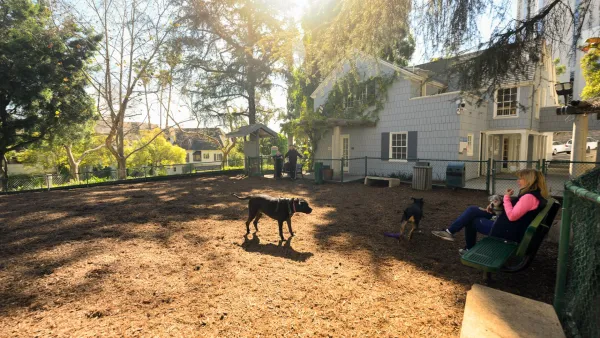
Op-ed: Finding the value in LA’s emptiest parks
Los Angeles has the nation's largest dog population, but a measly 14 dog parks. Adaptive reuse can help bridge this gap.
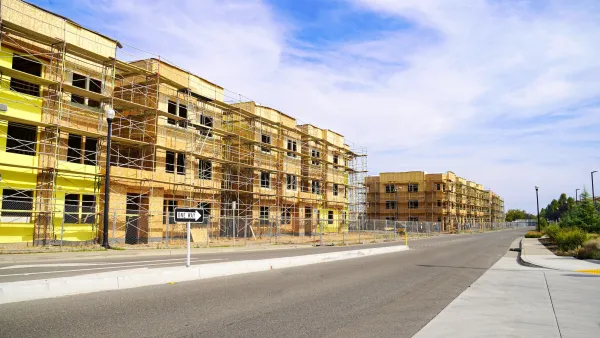
2025 Brought Seismic Changes to California Housing Laws
New state laws and policies created in reaction to devastating wildfires could spell massive changes for Southern California’s housing landscape.

Planetizen Federal Action Tracker
A weekly monitor of how Trump’s orders and actions are impacting planners and planning in America.

California plans to bury El Niño’s downpour
If the state plays its cards right, it may be able to store a billion acre-feet of El Niño’s water in aquifers.

Chicago breaks ground on $3 billion megadevelopment
The new neighborhood, titled Foundry Park, will one day host 3,700 residences.

California High-Speed Rail Authority CEO resigns after $600,000 scandal
Under Ian Choudri, the authority used taxpayer dollars to fund first class flights and trips to nightclubs.

Want to study the Missouri River? Soon, you may need unanimous approval from 10 states
Legislation would require 10 governors’ permission to study or build projects moving water outside the basin.

Desperate measures: Advocates weigh draining Lake Powell to fill Colorado River
Draining the reservoir could reduce evaporation losses by a couple hundred thousand acre-feet.

FREE Course: Walkable City 1: Why Walkability?
After describing his path towards focusing on walkability as the essence of good planning, Jeff Speck marches through his five principal reasons for making more walkable places.
Reinventing Malls: Planning Alchemy—Turning Gray Fields Into Gold
The course focuses on the opportunities and imperatives that shape reinvention of mall sites.

City of Rosemead
Rutgers University, Edward J. Bloustein School of Planning and Public Policy
One Hundred Miles
Hunter College, City University of New York (CUNY)
The Architects Foundation
University of Cincinnati Online
City of Cambridge
Montrose County
The Pocatello Development Authority