A district judge has thrown out a lawsuit challenging local authority to approve an under-construction bus rapid transit project in Utah.



"A 4th District judge on Monday derailed a lawsuit seeking to allow Provo voters to halt a controversial $190 million bus rapid transit (BRT) project already under construction," reports Lee Davidson
The lawsuit was enabled by a provision in the Utah Constitution that allows residents to collect signatures "to force an election about overturning any legislative action by a city council," according to Davidson. Administrative acts, however, "are exempt from challenge via referendum."
In effect, "Judge Samuel McVey upheld Provo's contention that when its City Council last year approved a no-cost 50-year lease to allow the Utah Transit Authority to use some city streets for the project, that was an administrative act — not legislative."
As for the bus rapid transit project in question, the Provo-Orem MAX route will travel 10.5 miles, connecting Utah Valley University, University Mall, Brigham Young University, downtown Provo, and the Provo Centre mall. Buses will travel about half the route on dedicated lanes.
Read the full story: Judge rejects move to stop controversial Provo transit project


Free Buses Are Filling Up in Utah
UTA's Bus Rapid Transit Line is yet to be completed but, by removing fares, the service has quintupled its ridership.
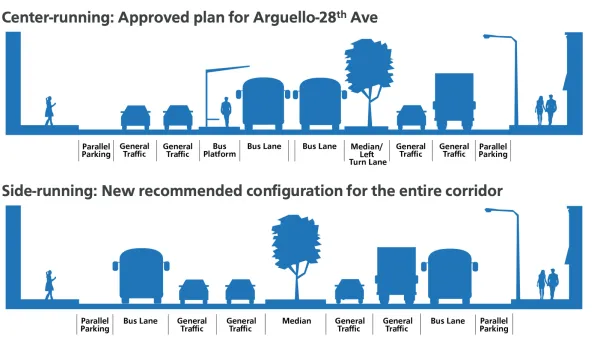
New Bus Only Lane Overcomes Opposition in San Francisco
Local business owners and the local elected official opposed the Geary transit-only lane project, but compromise and wide public support got the project across the finish line.
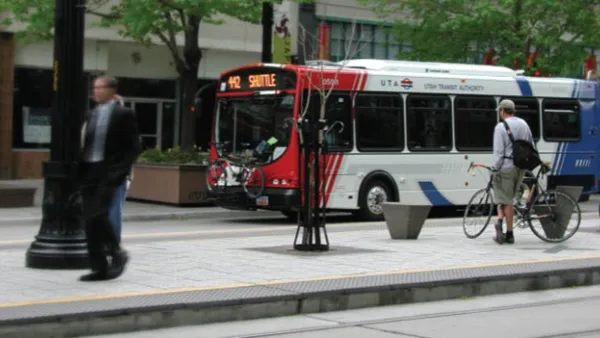
Utah Transit Officials Promote BRT
The state’s transit agency is building out new bus rapid transit lines, but has not reversed the sweeping cuts to local bus service made last year.

Planetizen Federal Action Tracker
A weekly monitor of how Trump’s orders and actions are impacting planners and planning in America.

Amtrak, CN end decades-long dispute with eight-year agreement
The new operating agreement establishes an updated framework for the companies to work together, including processes to resolve disputes.

Judges permit Denver to divert 77,000 acre feet from the Colorado River for reservoir expansion
Overuse and climate change have caused the Colorado River’s water levels to plummet.

NYC DOT wants faster, more permanent street upgrades
The city is examining ways to build more concrete infrastructure without getting entangled in 'decades-long' projects.

'Something we’ve never seen before:' rising utility rates could strain city finances nationwide
Data centers, climate change and other factors have caused utility rates in the United States to increase by 38% since 2020.

Trump to overrule local leaders, lease millions of acres of America’s Pacific Island territories’ seafloors to mining companies
International law says that the Indigenous people of America’s territories have a right to prior and informed consent regarding projects that impact their countries.

FREE Course: Walkable City 1: Why Walkability?
After describing his path towards focusing on walkability as the essence of good planning, Jeff Speck marches through his five principal reasons for making more walkable places.
Reinventing Malls: Planning Alchemy—Turning Gray Fields Into Gold
The course focuses on the opportunities and imperatives that shape reinvention of mall sites.

Harvard University Graduate School of Design
KFH Group Inc.
Greater Baltimore Committee
The Architects Foundation
University of Cincinnati Online
The Pocatello Development Authority
The Urban Renewal Agency of the City of Pocatello