Streetsblog tells the story of how a Toledo resident got involved in complete streets activism in her community.


A year ago, the city of Toledo received an $11 million federal grant to add a fifth lane to a road between West Toledo and the Ottawa Hills suburb.
The project would have required demolishing at least 12 homes. But thanks to the organizing of longtime resident Dana Dunbar, the city has now agreed to abandon the road-widening plan, federal funding and all; in fact, Dunbar is now working to get the street reduced to just three lanes.
Streetsblog USA's Angie Schmitt spoke to Dunbar, a small business owner, about how this campaign launched her into transportation advocacy. After researching walkability and complete streets, she was able to mobilize the community to bring forth a perspective that the city engineers hadn't considered.
“They said, ‘It’s a collector arterial,'” Dunbar recalled. “But we said, ‘No, it’s a neighborhood.”
Read the full story: How a Toledo Mom Stopped a Destructive Road Widening

Retrofitting Long Island Suburbs For The Pedestrian
Complete streets, road diets, streetscape improvements - geared to promote suburban downtowns for new residents who seek access to amenities without having to drive is a hit for some towns who have successfully obtained government grants to fund them
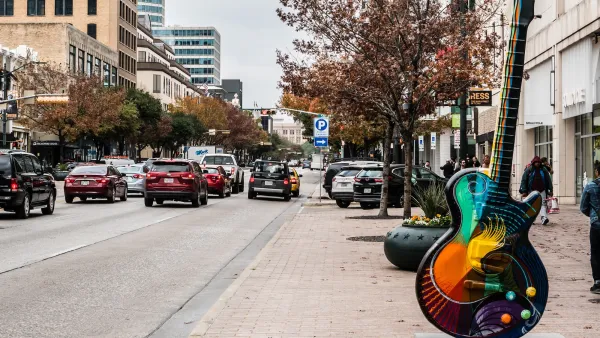
Austin Kicks off Multimodal Congress Avenue Redesign
The Congress Avenue Urban Design Initiative is bringing new pedestrian infrastructure and ‘storefront activation zones’ to the popular street.
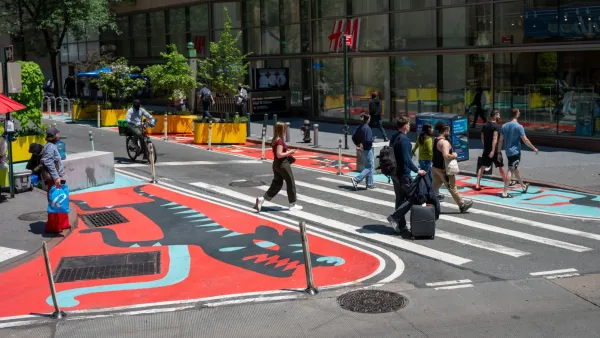
See Downtown Brooklyn’s Dramatic Complete Streets Transformation
A streetscape redesign spearheaded by the Downtown Brooklyn Partnership has quickly made many of Brooklyn’s streets unrecognizable.

Planetizen Federal Action Tracker
A weekly monitor of how Trump’s orders and actions are impacting planners and planning in America.

Amtrak, CN end decades-long dispute with eight-year agreement
The new operating agreement establishes an updated framework for the companies to work together, including processes to resolve disputes.

Judges permit Denver to divert 77,000 acre feet from the Colorado River for reservoir expansion
Overuse and climate change have caused the Colorado River’s water levels to plummet.

Boston has spent millions making the Green Line more accessible — and there’s no end in sight
While the city has invested millions into expanding and adding platforms to the Green Line to make it more accessible, new train cars set to arrive next year will be too tall for disabled passengers to board without raising the current platforms.

Idaho may see an 18% drop in federal surface transit funding — the largest estimated cut in the US
Transit systems in rural communities are much more reliant on federal funding to provide their services.

How ‘post-disaster gentrification’ alters neighborhoods after natural calamities
After hurricanes, fires or other calamities, the original residents of a community are often replaced by younger, wealthier residents.

FREE Course: Walkable City 1: Why Walkability?
After describing his path towards focusing on walkability as the essence of good planning, Jeff Speck marches through his five principal reasons for making more walkable places.
Reinventing Malls: Planning Alchemy—Turning Gray Fields Into Gold
The course focuses on the opportunities and imperatives that shape reinvention of mall sites.

City of Wisconsin Rapids
Harvard University Graduate School of Design
KFH Group Inc.
The Architects Foundation
University of Cincinnati Online
The Pocatello Development Authority
The Urban Renewal Agency of the City of Pocatello