In short, transit wasn't really there. When transportation network services went down, people felt stranded. Transit friendliness can go a long way.


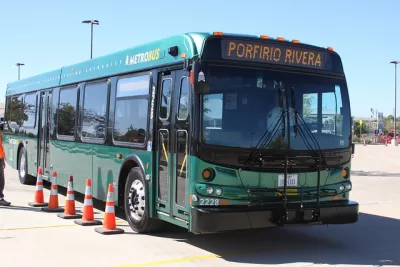
In a Medium piece, the folks behind the Transit app discuss why the transportation conversation at South by Southwest focused only on rideshare. "SXSWers were bereft of their beloved ridesharing services, forced to wait for cabs in the rain with 'no alternatives'. We racked our brains for a possible solution. We think we found it: Fixed-route ridesharing."
In other words, transit. But in central Austin, transit is sparse and hard to use compared with other central cities. Changing that could shift the narrative at future festivals. "Our data suggests that there's an exponential relationship between 'transit friendliness' and the number of trips that actually get taken. Basically what that means is that by making a destination a bit more transit friendly you end up getting a lot more people taking transit."
The tradeoff between transportation network companies and transit should (in theory at least) depend on the type of urban landscape you're traversing. "Ridesharing is easy and convenient. It's a fantastic complement to public transit. But it shouldn't be the default mobility choice in the downtown core of a big American city."
Read the full story: The media focused on the wrong thing during SXSW
Austin Hopes to Buck Tradition with Anti-Gentrification Measures in its New Transit Plan
Project Connect promises to prioritize equity and inclusion with $300 million dedicated to anti-displacement efforts.
Uber App Feature Integrates Transit and Ridesharing
Uber’s "Make My Train" app feature lets riders better plan journeys across modes.
Via Rideshare Service Expands in Chicago
The company hopes that a broader service area and discounted rides will help people better access transit services.

Planetizen Federal Action Tracker
A weekly monitor of how Trump’s orders and actions are impacting planners and planning in America.

California plans to bury El Niño’s downpour
If the state plays its cards right, it may be able to store a billion acre-feet of El Niño’s water in aquifers.

Desperate measures: Advocates weigh draining Lake Powell to fill Colorado River
Draining the reservoir could reduce evaporation losses by a couple hundred thousand acre-feet.

Mamdani’s pied-à-terre tax survives legal challenge
A panel of judges found that the plaintiffs failed to demonstrate injury as a result of New York City's implementation of the tax.

Eastern Nebraska is running out of electricity
Data centers and electrification are straining eastern Nebraska’s grid, throttling economic development.

Seattle passes record-breaking transit services expansion
Proposition 1 will double the city’s transit tax to add 95,000 more bus trips and preserve 180,000 bus trips annually.

FREE Course: Walkable City 1: Why Walkability?
After describing his path towards focusing on walkability as the essence of good planning, Jeff Speck marches through his five principal reasons for making more walkable places.
Reinventing Malls: Planning Alchemy—Turning Gray Fields Into Gold
The course focuses on the opportunities and imperatives that shape reinvention of mall sites.

City of Rosemead
Rutgers University, Edward J. Bloustein School of Planning and Public Policy
One Hundred Miles
University of Michigan School for Environment and Sustainability (SEAS)
Hunter College, City University of New York (CUNY)
The Architects Foundation
City of Cambridge
Montrose County
The Pocatello Development Authority