Natalie Moore details her experience in Chicago's Chatham neighborhood as the child of black home owners in a segregated city.


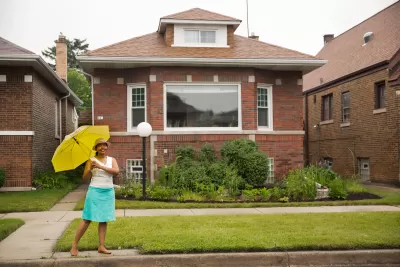
"My parents, Joe and Yvonne Moore, married in 1974, and their first home decision was a cultural and practical choice: They wanted to live in an African-American community on Chicago’s South Side, put down roots and start a family," Natalie Moore writes for WBEZ, detailing her family's experiences as black homeowners. "Before 1948, Chatham had been all white and deliberately kept blacks out, an example of the discrimination that met migrants from the South," Moore writes. After the Supreme Court ruled that this discrimination was illegal, the neighborhood went from all white to all black. Moore describes seeing white people on the Red Line only when there was a White Sox game at Comisky Park several miles north of her home.
When she was in college, Moore's parents sold their home in Chatham, the timing turned out to work in their favor, because of the housing collapse. "Subprime loans were targeted at black homeowners, and those loans were concentrated in black neighborhoods, like Chatham," Moore reports. Moore faced a whole other battery of issues when she became a homeowner in Chicago's Bronzeville neighborhood. When Moore was looking to move to a larger home, she found it hard to sell her condo because the bank’s appraiser would not give her what seemed to be a fair valuation. Moore spoke with a realtor who said this is an issue homeowners face particularly in black neighborhoods. "Even though Chicago has seen a glut of condos, she said, “there are unique forces at play in black neighborhoods when it comes to homeownership, like fighting bad appraisals," Moore writes.
Read the full story: Black Homeownership: The Promise and The Pitfalls


Racial Disparity in Home Lending Is Today's Redlining
According to a new report detailing discriminatory lending in Chicago, people in majority-white neighborhoods continue to receive more loans, and in greater amounts, than people in majority-Black and majority-Latino areas.

No Slowdown of Out-Migration of Black Residents from Chicago
The city of Chicago continues to see a decline in population, including tens of thousands of African-Americans who have left in recent years.

Opportunity Zone Investors Look to Fuel Tech in Chicago
One venture plans to fund a 100-acre campus for tech, bioscience, and medical research in Chicago's Bronzeville neighborhood.

Planetizen Federal Action Tracker
A weekly monitor of how Trump’s orders and actions are impacting planners and planning in America.

Amtrak, CN end decades-long dispute with eight-year agreement
The new operating agreement establishes an updated framework for the companies to work together, including processes to resolve disputes.

Judges permit Denver to divert 77,000 acre feet from the Colorado River for reservoir expansion
Overuse and climate change have caused the Colorado River’s water levels to plummet.

NYC DOT wants faster, more permanent street upgrades
The city is examining ways to build more concrete infrastructure without getting entangled in 'decades-long' projects.

'Something we’ve never seen before:' rising utility rates could strain city finances nationwide
Data centers, climate change and other factors have caused utility rates in the United States to increase by 38% since 2020.

Trump to overrule local leaders, lease millions of acres of America’s Pacific Island territories’ seafloors to mining companies
International law says that the Indigenous people of America’s territories have a right to prior and informed consent regarding projects that impact their countries.

FREE Course: Walkable City 1: Why Walkability?
After describing his path towards focusing on walkability as the essence of good planning, Jeff Speck marches through his five principal reasons for making more walkable places.
Reinventing Malls: Planning Alchemy—Turning Gray Fields Into Gold
The course focuses on the opportunities and imperatives that shape reinvention of mall sites.

Harvard University Graduate School of Design
KFH Group Inc.
Greater Baltimore Committee
The Architects Foundation
University of Cincinnati Online
The Pocatello Development Authority
The Urban Renewal Agency of the City of Pocatello