In spite of a host of problems, over 1,000 parcels have been acquired and construction is occurring in nine areas in the Central Valley, centering on Fresno. Limited service from San Francisco to Bakersfield could begin in 2025.


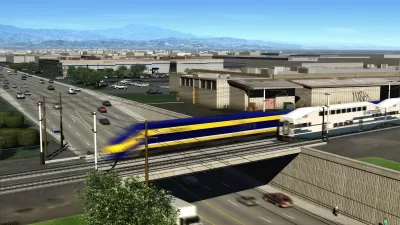
"America’s biggest infrastructure project is both in limbo and full-speed ahead," reports Kurtis Alexander for the San Francisco Chronicle. It's become the poster child of boondoggles for Republicans in Sacramento and the nation's capital, but in the Central Valley, particularly around its largest city, Fresno, it's presence can not be overlooked, literally-speaking in some areas.
Far from the wrangling in Sacramento and Washington, work on the first 119-mile segment, from Madera to just outside Bakersfield, has been under way for almost two years.
Just south of downtown Fresno, the largest undertaking so far — a half-mile-long viaduct that will lift trains from the city into distant farmland — is taking shape in an area of old factories and warehouses. Already, the new structure is a monolith helping define the Fresno skyline....The columns of the superstructure stand nearly 80 feet tall, while the bridge deck is emerging as a sleek, aerial concourse.
It’s very satisfying to see,” said California High-Speed Rail’s Central Valley director, Diana Gomez, as she led a tour of the loud, muddy construction site. “Everyone can see this piece from Highway 99.”
Alexander writes that the project is not being done in one, expanding location, as one might expect, but at nine major sites. Twelve miles north of the Fresno viaduct described above, "a nearly mile-long viaduct is rising over the San Joaquin River, while about 25 miles to the north, in Madera County, a bridge is materializing across the Fresno River."
One of the most significant activities, moving six lanes of Highway 99 about 100 feet to the west for 2 miles, will allow trains to squeeze through a dense part of central Fresno.
“There’s really no place yet you can stand and see for miles and miles and say, ‘Yeah, it’s coming together,’” said Dan Richard, chair of the Rail Authority's governing board, looking up at the emerging bridge over the San Joaquin River. “But once these few projects get done, connecting them comes fast.”
However, litigation by opponents living in the Central Valley, "planning snafus and problems with land acquisitions have set the project back at least three years."
It's uncertain whether the first, 500-mile phase from San Francisco to San Jose, will receive sufficient funding to be built. The California High-Speed Rail Authority was expecting to receive more federal funding, which Congress has since eliminated, and although some private rail operators have shown some interest, none are willing to invest in the project, unlike the nation's other high-speed rail project connecting Dallas to Houston.
"Texas Central Partners plans to begin construction on the rail in late 2017 and will work closely with Japan Railway to localize the firm’s Shinkansen bullet train technology," reported Bill Hethcock for the Dallas Business Journal last May. "The project is scheduled for completion in 2021 with the first full year of operations in 2022."
The California High-Speed Rail Authority hopes to launch bullet trains from San Francisco to Bakersfield by 2025, but without new funding, running tracks to Los Angeles will be challenging.
Read the full story: High-speed rail taking shape even as opponents seek to kill it

A Change of Direction for California High-Speed Rail
In the face of political opposition and mounting construction costs in Southern California, the state High-Speed Rail Authority has chosen to build north from the Central Valley to San Jose rather than south from Fresno to the San Fernando Valley.
Fresno Pins Economic Hopes on High-Speed Rail
The Central Valley town anticipates an economic boost when the long-awaited California High-Speed Rail begins operations.
Governor's Transportation and Climate Actions Stir Controversy in California
California Governor Gavin Newsom issued an executive order last month directing state agencies to consider climate goals in their spending and operations. Two weeks later, three highway widening projects were deleted, and locals are crying foul.

Planetizen Federal Action Tracker
A weekly monitor of how Trump’s orders and actions are impacting planners and planning in America.

Northwest rail fans eager for Sept. 30 debut of Amtrak’s Airo fleet
Get ready for that new train smell and more seats. But they won’t go faster or run more frequently on the Cascades route in Washington and Oregon.
Record-breaking wildlife overpass in Colorado brings 91% reduction in animal collisions
Prior to the overpass, vehicles were hitting one deer per day on Colorado’s Interstate 25.

Detroit to transform waterfront with $2.2 billion investment
Developers will convert about 18 acres of unused parking lot space into civic spaces.

‘Going backwards:’ Baltimore mayor, students rally against state's transit funding plan
Maryland's proposed six-year plan provides no funding for Baltimore’s BMORE bus program and reduces its road maintenance funding.

Trump wants to cancel nearly 98% of funding for HUD housing support program
Multiple housing groups are suing the administration in an effort to preserve the funding.

FREE Course: Walkable City 1: Why Walkability?
After describing his path towards focusing on walkability as the essence of good planning, Jeff Speck marches through his five principal reasons for making more walkable places.
Reinventing Malls: Planning Alchemy—Turning Gray Fields Into Gold
The course focuses on the opportunities and imperatives that shape reinvention of mall sites.

City of Thousand Oaks
City of Wisconsin Rapids
Harvard University Graduate School of Design
The Architects Foundation
University of Cincinnati Online
Northern Illinois Transit Authority (NITA)
The Pocatello Development Authority
The Urban Renewal Agency of the City of Pocatello