New York continues to grow, and as the city changes, so does its garbage.


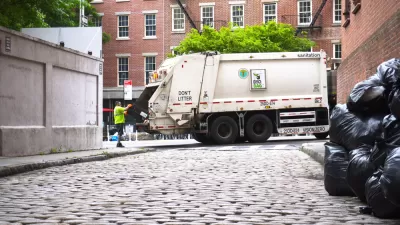
The city of New York has long had a reputation for being dirty. Tidying the city is no small task. "(Cleaning New York) is getting harder and more expensive as the city's all-time-high population of 8.5 million and booming tourism mean more people -- and more trash -- in more places," Winnie Hu write for the New York Times.
Costs are outpacing the city’s growth. "The Sanitation Department spent $58.2 million to clean streets last year, up from $49.5 million the year before," Hu reports. Beyond employing garbage men and woman, the city also employs cleanup crews in places like Time Square. "NYC Cleanup doubles as a job training program, with community organizations employing people on cleaning crews who have been homeless or in prison," writes Hu.
Read the full story: New York’s Growth Can Be Measured in Trash Bags

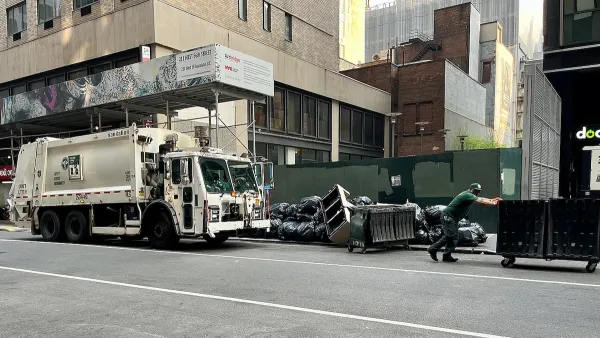
Parked Cars Hamper NYC Trash Containerization Effort
Sanitation workers must manually collect bags from containers blocked by parked cars, slowing a process that is meant to be safer and more efficient.
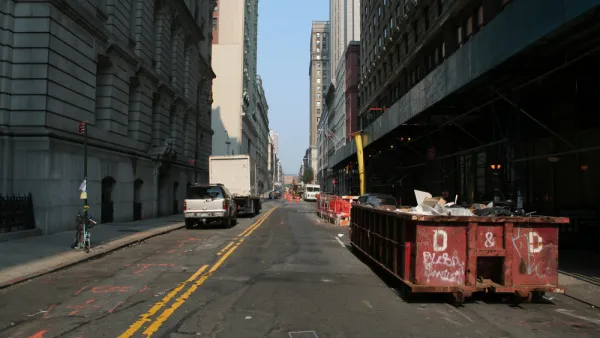
N.Y.C. Law Will Establish Waste Collection Zones
A new law will reorganize the city’s trash collection network and reduce the number of sanitation trucks crisscrossing the city.
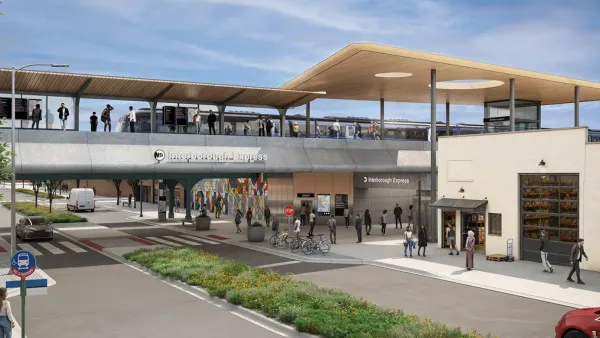
NYC releases new renderings for $5.5 billion Interborough Express
The slated stations will have a modern look, enhanced lighting and improved audio announcements.

Planetizen Federal Action Tracker
A weekly monitor of how Trump’s orders and actions are impacting planners and planning in America.

Amtrak, CN end decades-long dispute with eight-year agreement
The new operating agreement establishes an updated framework for the companies to work together, including processes to resolve disputes.

Judges permit Denver to divert 77,000 acre feet from the Colorado River for reservoir expansion
Overuse and climate change have caused the Colorado River’s water levels to plummet.

Idaho may see an 18% drop in federal surface transit funding — the largest estimated cut in the US
Transit systems in rural communities are much more reliant on federal funding to provide their services.

How ‘post-disaster gentrification’ alters neighborhoods after natural calamities
After hurricanes, fires or other calamities, the original residents of a community are often replaced by younger, wealthier residents.

Maryland local governments examine if they should have more power to raise property taxes
Maryland’s housing market is out of reach for the majority of moderate-income residents.

FREE Course: Walkable City 1: Why Walkability?
After describing his path towards focusing on walkability as the essence of good planning, Jeff Speck marches through his five principal reasons for making more walkable places.
Reinventing Malls: Planning Alchemy—Turning Gray Fields Into Gold
The course focuses on the opportunities and imperatives that shape reinvention of mall sites.

Harvard University Graduate School of Design
KFH Group Inc.
Greater Baltimore Committee
The Architects Foundation
University of Cincinnati Online
The Pocatello Development Authority
The Urban Renewal Agency of the City of Pocatello