Many families cannot afford to live in San Francisco, where housing prices are high and houses fit for families raising children are hard to come by.


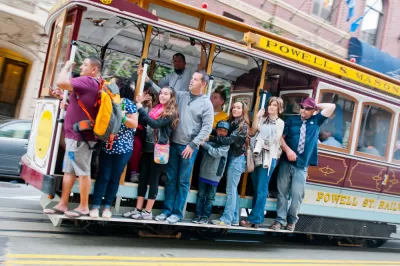
One side effect of the high cost of housing in San Francisco is that it’s pushing families out of the city. "San Francisco notoriously has the smallest percentage of kids — 13.4 percent — of any city in the nation. But while San Francisco officials sweat and bicker over affordable housing, they rarely talk about family housing," reports Heather Knight for the San Francisco Chronicle.
Supervisor Norman Yee commissioned the city's planning department to come up with a report on the issue, and the results paint a grim picture for families. "Of all the homes across San Francisco with three or more bedrooms, just 30 percent of them are occupied by families with children. Many of them are inhabited by unrelated roommates, couples whose kids are grown or single people," writes Knight. The kind of demand that has families competing with singles that would break them up points to an extraordinary demand for housing of many kinds, Yee feels the problem is caused, in part, by what developers wish to build. "Yee said he’s tired of seeing plans for high-rises filled with studios and one-bedroom apartments and open spaces that are clearly designed for adults," Knight writes. It's also the case that there's simply a great deal of demand, some of which may be due to Yee and others opposing dense low-income developments.
Read the full story: SF housing shortage leaves little room for families

How a San Francisco Land Trust is Preserving Affordable Housing for Artists
The Artist Space Trust has received $10 million in properties bequeathed by artists that will become permanently affordable housing.

San Francisco is in a “Doom Loop.” A Legendary Artist and Burning Man Founder Knows how to Revive it.
Artists made San Francisco what it was. They might just be the key to its future.
San Francisco's School District Spent $105M To Build Affordable Housing for Teachers — And That's Just the Beginning
SFUSD joins a growing list of school districts using their land holdings to address housing affordability challenges faced by their own employees.

Planetizen Federal Action Tracker
A weekly monitor of how Trump’s orders and actions are impacting planners and planning in America.

‘Going backwards:’ Baltimore mayor, students rally against state's transit funding plan
Maryland's proposed six-year plan provides no funding for Baltimore’s BMORE bus program and reduces its road maintenance funding.

Detroit to transform waterfront with $2.2 billion investment
Developers will convert about 18 acres of unused parking lot space into civic spaces.

This Boston neighborhood is filling its roads with obstacles — intentionally
Somerville is embracing ‘extreme street makeovers’ to make its roads safer for pedestrians and cyclists.

Planned $2 billion courthouse in MA sparks tension with local government
Springfield owns an essential piece of the land developers intend to build on, and some city officials do not want to see the project come to fruition.

Californians can now transform balconies into power generators
Gov. Gavin Newsom has legalized plug-in solar technology, which allows residents to plug solar panels directly into their outlets

FREE Course: Walkable City 1: Why Walkability?
After describing his path towards focusing on walkability as the essence of good planning, Jeff Speck marches through his five principal reasons for making more walkable places.
Reinventing Malls: Planning Alchemy—Turning Gray Fields Into Gold
The course focuses on the opportunities and imperatives that shape reinvention of mall sites.

City of Thousand Oaks
City of Wisconsin Rapids
Harvard University Graduate School of Design
The Architects Foundation
University of Cincinnati Online
Northern Illinois Transit Authority (NITA)
The Pocatello Development Authority
The Urban Renewal Agency of the City of Pocatello