In a welcome turnabout of the usual state of affairs, a Philadelphia construction site gives a lane of traffic to pedestrians to make up for the three blocks of sidewalk it's taking.


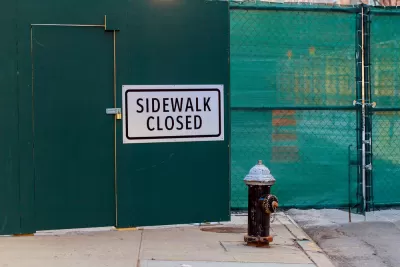
When buildings need to rope off sidewalks for construction projects, American pedestrians are used to having to walk in the street and dodge traffic. However, during the construction of a three-block-long shopping mall on Philadelphia's Market Street, a lane of traffic is being blocked off and given to pedestrians. "Traffic engineers call such passageways 'cattle chutes,' an unfortunate name for a public amenity that should be required infrastructure in any modern city." Inga Saffron writes for The Philadelphia Inquirer.
City officials tell Saffron, "Not only will the walkway occupy a full traffic lane on Market Street, the sheltered passages will be the most extensive pedestrian safety zone ever created here." This is a wise approach especially in heavily walked neighborhoods were foot traffic is the life blood of many businesses. This particular stretch of sidewalk sits between Philadelphia's historic City Hall and the Independence Mall.
Read the full story: Giving up a piece of the street for the sake of Philly pedestrians

The number of kids walking to school dropped from over 50% to 11% since the 1960s
Unsafe pedestrian infrastructure makes walking to school dangerous or impossible for a growing number of American students.
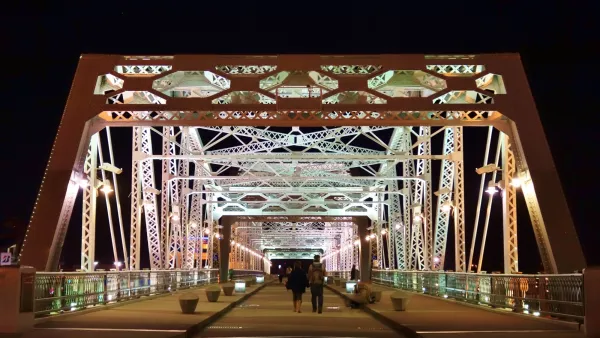
Nashville Releases 5-Year 'WalknBike' Plan
The plan lays out the city's plans for improving its bike infrastructure and sidewalk network.
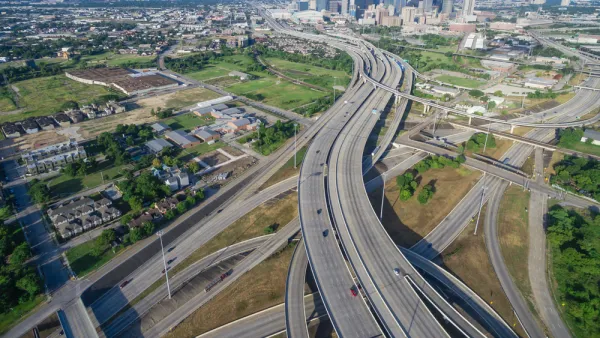
Refugees Learn to Survive as Pedestrians on Houston's Dangerous Streets
For one refugee family, living in Houston has meant facing a host of new challenges as they traverse the city’s roadways without a car.

Planetizen Federal Action Tracker
A weekly monitor of how Trump’s orders and actions are impacting planners and planning in America.

California plans to bury El Niño’s downpour
If the state plays its cards right, it may be able to store a billion acre-feet of El Niño’s water in aquifers.

Desperate measures: Advocates weigh draining Lake Powell to fill Colorado River
Draining the reservoir could reduce evaporation losses by a couple hundred thousand acre-feet.

Mamdani’s pied-à-terre tax survives legal challenge
A panel of judges found that the plaintiffs failed to demonstrate injury as a result of New York City's implementation of the tax.

Eastern Nebraska is running out of electricity
Data centers and electrification are straining eastern Nebraska’s grid, throttling economic development.

Seattle passes record-breaking transit services expansion
Proposition 1 will double the city’s transit tax to add 95,000 more bus trips and preserve 180,000 bus trips annually.

FREE Course: Walkable City 1: Why Walkability?
After describing his path towards focusing on walkability as the essence of good planning, Jeff Speck marches through his five principal reasons for making more walkable places.
Reinventing Malls: Planning Alchemy—Turning Gray Fields Into Gold
The course focuses on the opportunities and imperatives that shape reinvention of mall sites.

City of Rosemead
Rutgers University, Edward J. Bloustein School of Planning and Public Policy
One Hundred Miles
University of Michigan School for Environment and Sustainability (SEAS)
Hunter College, City University of New York (CUNY)
The Architects Foundation
City of Cambridge
Montrose County
The Pocatello Development Authority