The semi-legal world of quick, informal city improvements called tactical urbanism is finding a home inside transit departments.


Interested citizens will sometimes intervene to solve small neighborhood problems, like repainting a faded crosswalk or placing wayfinding signs on lamp posts. The practice has been called "tactical urbanism" and it offers the advantage of taking small actions to solve problems that cities, slowed by bureaucracy or competing interests, can be slow to address. Some transit agencies, seeing the beneficial effects of such actions, are adopting similar tactics. They’re looking for small quick fixes that can be implemented and tested at low costs.
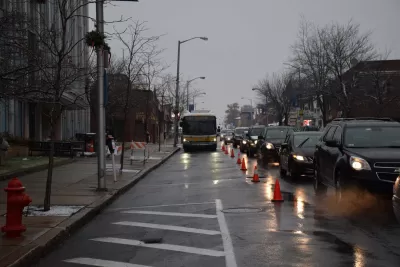
Among other examples, a post on the TransitCenter website cites an activation from New York City: "Recently, the city expanded its 'quick delivery' repertoire for bus corridors with a rubber bus bulb-out or curb extension along the Utica Avenue corridor rather than traditional cement." Another bus project was laid out with the help of some orange cones, "In Everett, Massachusetts, a pilot project recently transformed a parking lane in a heavily congested portion of Broadway/Route 99 into bus-only lane during rush hour." Some city problems need huge spending and coordinated efforts to solve, but many don't, and nimble departments may be able find many ways to help communities.
FULL STORY: Why Tactical Transit is the Next Big Thing

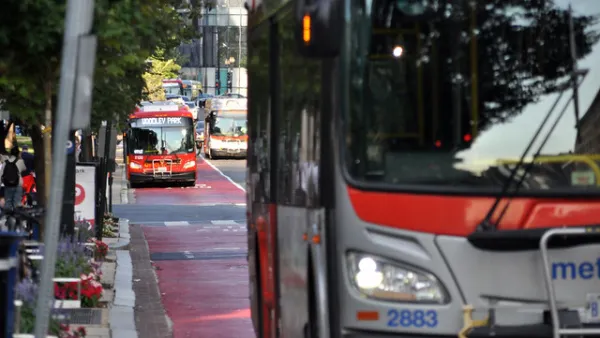
Watch D.C.'s New Red Bus Lanes in Action
Streetfilms documents the early results of an ambitious transit pilot project in Washington, D.C.
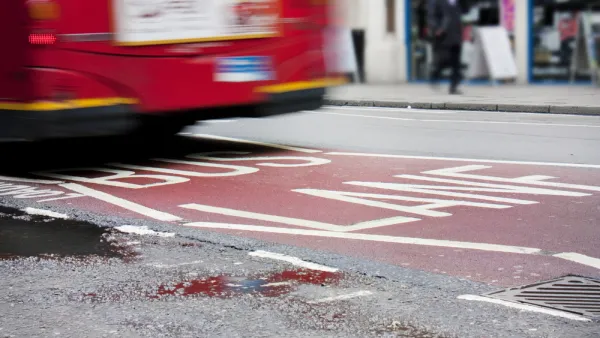
San Francisco's Red Carpet Transit Lanes to Continue Through March Evaluation
San Francisco's red, transit-only lanes are a demonstration project. The lanes first appeared in 2013 and were supposed to last two years, with state and federal regulators to determine whether they would continue. The state evaluation began Dec. 6.
Indianapolis Puts Design Ideas to the Test With Pedestrian-Friendly Pilot Project
As it works to gather the $60 million necessary to implement permanent changes to Monument Circle, Indianapolis is testing ideas for how to make the location more pedestrian friendly.

The state-sanctioned urbicide of Austin
People don’t kill cities. Freeways do.

US to reduce Colorado River water deliveries to Mexico
A new Colorado Treaty amendment reduces Mexico’s Colorado River water allocation by 250,000 acre feet.

New Jersey’s second-largest city bans standalone data centers
Jersey City will continue to allow co-location facilities, such as those meant for research institutions that store their own data.

Amtrak not solely to blame for New Jersey commuter rail's unreliability, report finds
A new study from the Garden State Initiative found that NJ Transit’s budget grew 20% across a 4 year period, but reliability declined significantly over the same period.

EPA erases limits on planet-warming pollution from power plants
Under Monday’s plan, power plants would still have some limits on how much mercury, arsenic and other contaminants they can emit.

Phoenix announces new on-demand transit service, more frequent RAPID buses
Both new services will launch in October, and are part of Phoenix's Project Effective Access Solutions for Easing Congestion.

FREE Course: Walkable City 1: Why Walkability?
After describing his path towards focusing on walkability as the essence of good planning, Jeff Speck marches through his five principal reasons for making more walkable places.
Reinventing Malls: Planning Alchemy—Turning Gray Fields Into Gold
The course focuses on the opportunities and imperatives that shape reinvention of mall sites.

Eagle County Government
Harvard University Graduate School of Design
Nashville Planning Department
The Architects Foundation
University of Cincinnati Online
The Pocatello Development Authority
The Urban Renewal Agency of the City of Pocatello
Journal of the American Planning Association