"The Idaho Stop,'"which describes bike riders treating stop signs as yield signs, got more support from a recent study by DePaul University.


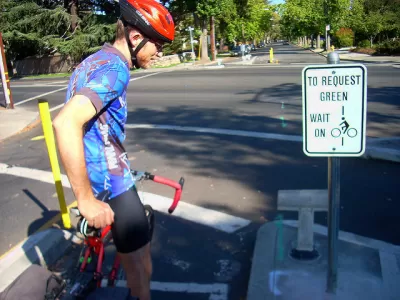
The Chicago Tribune's Mary Wisniewski and Streetsblog Chicago's John Greenfield analyze a new study out of Depaul University that supports the Idaho Stop. According to Greenfield, a "[n]ew DePaul study that calls for relaxing laws requiring bike riders to come to a complete stop at stop signs and always wait for a green before proceeding through a stoplight."
The research suggests bikers could use the "Idaho Stop," meaning, "…cyclists to treat stop signs like yield signs by decelerating and checking to make sure there’s no cross traffic before proceeding through the intersection, rather than putting a foot down," Greenfield writes. The idea is supported, not just for convenience, but also for safety reasons. "The study also noted that it can actually be safer for cyclists to proceed through intersections in advance of the green, because it eliminates the possibility of being struck by turning motorists after the light changes," Greenfield explained.
The new study adds a wrinkle to the ongoing debate over the Idaho Stop, which is a point of continuous controversy between bicycle advocates and motorists.
Read the full story: "Idaho Stop" in the Name of Love: DePaul Study Endorses Rational Cycling


Chicago Sees Record Shared Bike, Scooter Use
Riders took over 11 million bike share and scooter trips in 2024.
Chicago Leads Nation in Biking Growth
Cycling as a mode share grew faster in the Windy City over the last five years than in any other major U.S. metropolis.

LeBron James Wants Kids to Bike
The NBA star says bikes have played an important role in his life, and he wants young people to have the same access and freedom that biking gave him.

Planetizen Federal Action Tracker
A weekly monitor of how Trump’s orders and actions are impacting planners and planning in America.

California plans to bury El Niño’s downpour
If the state plays its cards right, it may be able to store a billion acre-feet of El Niño’s water in aquifers.

Chicago breaks ground on $3 billion megadevelopment
The new neighborhood, titled Foundry Park, will one day host 3,700 residences.

California High-Speed Rail Authority CEO resigns after $600,000 scandal
Under Ian Choudri, the authority used taxpayer dollars to fund first class flights and trips to nightclubs.

Want to study the Missouri River? Soon, you may need unanimous approval from 10 states
Legislation would require 10 governors’ permission to study or build projects moving water outside the basin.

Desperate measures: Advocates weigh draining Lake Powell to fill Colorado River
Draining the reservoir could reduce evaporation losses by a couple hundred thousand acre-feet.

FREE Course: Walkable City 1: Why Walkability?
After describing his path towards focusing on walkability as the essence of good planning, Jeff Speck marches through his five principal reasons for making more walkable places.
Reinventing Malls: Planning Alchemy—Turning Gray Fields Into Gold
The course focuses on the opportunities and imperatives that shape reinvention of mall sites.

City of Rosemead
Rutgers University, Edward J. Bloustein School of Planning and Public Policy
One Hundred Miles
Hunter College, City University of New York (CUNY)
The Architects Foundation
University of Cincinnati Online
City of Cambridge
Montrose County
The Pocatello Development Authority