Students at Emerson College live with the frustrations of the intersection of Boylston and Tremont streets everyday. They also have ideas for how to fix the intersection.


"Every day, swarms of Boston pedestrians scurry from all four corners of the intersection at Boylston and Tremont streets, jostling in the middle of the road like concertgoers in a mosh pit at a heavy-metal concert, as they try to beat the crosswalk countdown signals before the lights turn green and cars begin to go," writes Steve Annear.
The problem described by Annear inspired a Civic Art and Design Studio at nearby Emerson College to produce a collection of proposals to improve the congested intersection. One of the ideas is simple: "add five seconds to the crosswalk signals, so that people aren’t scrambling to safety in the final moments before drivers hit the gas and the ominous orange hand appears telling pedestrians to stay put."
The students worked in groups focused on improvements for "pedestrians, cyclists, drivers, and public transit vehicles." The student's effort is well-timed, according to Annear: "The city already is reviewing traffic signal timing in the area where Boylston and Tremont streets meet as part of a citywide effort…"
FULL STORY: Emerson students want more time to cross the street

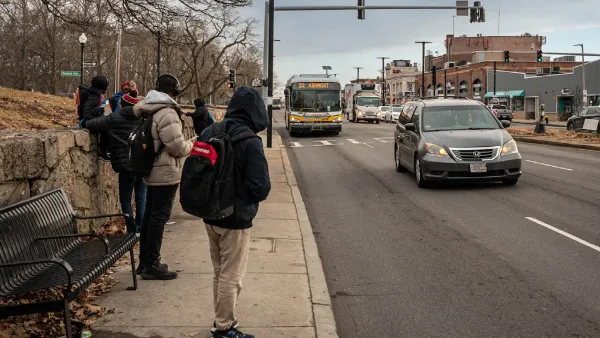
Boston’s Blue Hill Avenue to Get BRT, Safety Improvements
The key bus corridor serves over 37,000 bus riders daily.
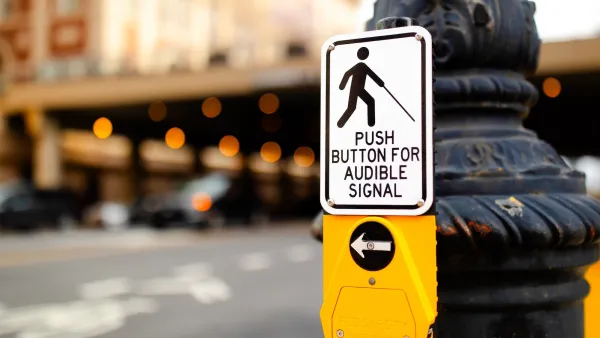
Report: Chicago surpassed its legal mandate for accessible pedestrian signals — but none passed inspections
Gaps in accessibility, placement and functionality highlight the importance of regular inspections and maintenance.
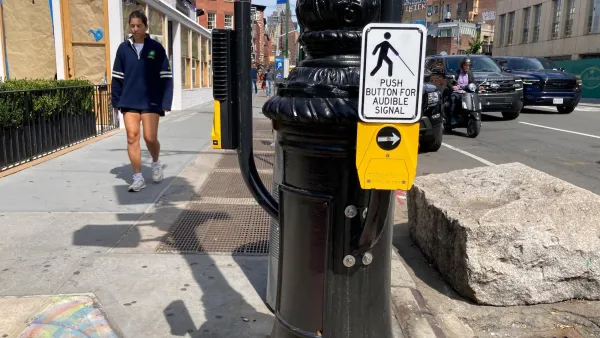
90% of NYC Intersections Lack Audible Crossing Signals for Blind Pedestrians
People with vision impairments rely on a complex network of tactile and audible signals to navigate cities.

Planetizen Federal Action Tracker
A weekly monitor of how Trump’s orders and actions are impacting planners and planning in America.

The state-sanctioned urbicide of Austin
People don’t kill cities. Freeways do.

US to reduce Colorado River water deliveries to Mexico
A new Colorado Treaty amendment reduces Mexico’s Colorado River water allocation by 250,000 acre feet.

5 New England states march closer to 800 megawatt wind energy project
Securing federal approval for the project may be complicated under the Trump administration, which has historically been hostile towards domestic wind power.

Baltimore to break ground on $50 million Transit Priority Project
The project will bring faster bus trips, safer streets and better bike connections to Baltimore.

Airbnb launches $250 million 'last-dollar financing' housing accelerator, makes first investment in Austin
The company will put $6.4 million towards affordable housing development in Texas’ capital.

FREE Course: Walkable City 1: Why Walkability?
After describing his path towards focusing on walkability as the essence of good planning, Jeff Speck marches through his five principal reasons for making more walkable places.
Reinventing Malls: Planning Alchemy—Turning Gray Fields Into Gold
The course focuses on the opportunities and imperatives that shape reinvention of mall sites.

Eagle County Government
Harvard University Graduate School of Design
Nashville Planning Department
The Architects Foundation
University of Cincinnati Online
The Pocatello Development Authority
The Urban Renewal Agency of the City of Pocatello
Journal of the American Planning Association