Alaska is warming about twice as fast as the rest of the continental United States, and the state is heading for the warmest year on record. The government has identified at least 31 Alaska towns and cities at risk of destruction.


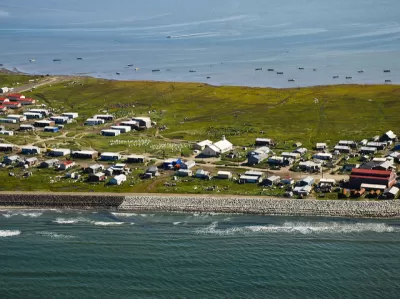
Reporter Erica Goode with the New York Times writes about the climate change impacts facing remote, rural Alaska villages:
With its proximity to the Arctic, Alaska is warming about twice as fast as the rest of the United States, and the state is heading for the warmest year on record. The government has identified at least 31 Alaska towns and cities at imminent risk of destruction, with Shaktoolik ranking among the top four. Some villages, climate change experts predict, will be uninhabitable by 2050, their residents joining a flow of climate refugees around the globe, in Bolivia, China, Niger and other countries.
These endangered Alaska communities face a choice. They could move to higher ground, a wrenching prospect that, for a small village, could cost as much as $200 million. Or they could stand their ground and hope to find money to fortify their buildings and shore up their coastline.
At least two villages farther up the western coast, Shishmaref and Kivalina, have voted to relocate when and if they can find a suitable site and the money to do so. A third, Newtok, in the soggy Yukon-Kuskokwim Delta farther south, has taken the first steps toward a move.
Read the full story: A wrenching choice for Alaska towns in the path of climate change
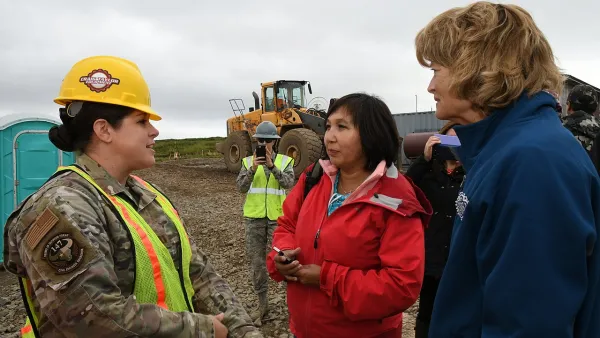
Alaska Village Becomes Test Case for Climate Change Relocation
The Yup’ik village of Newtok is the first Alaska community to begin a full-scale relocation necessitated by the impacts of climate change. Another 31 Alaska communities remain vulnerable.
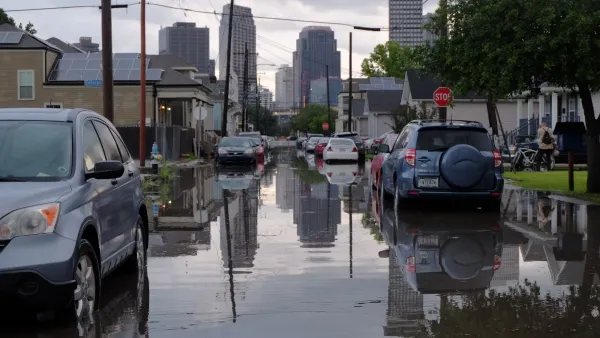
Study: New Orleans sea level rise is at 'point of no return'
Research shows that the city could be surrounded by water by the end of this century.
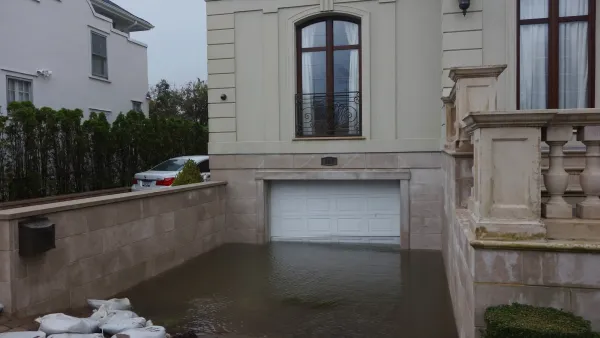
Over 500 NYC ‘Blue Zones’ at Risk of More Destructive Floods
High-risk flood zones cover roughly 20% of the city’s land.

Planetizen Federal Action Tracker
A weekly monitor of how Trump’s orders and actions are impacting planners and planning in America.

California plans to bury El Niño’s downpour
If the state plays its cards right, it may be able to store a billion acre-feet of El Niño’s water in aquifers.

Desperate measures: Advocates weigh draining Lake Powell to fill Colorado River
Draining the reservoir could reduce evaporation losses by a couple hundred thousand acre-feet.

Mamdani’s pied-à-terre tax survives legal challenge
A panel of judges found that the plaintiffs failed to demonstrate injury as a result of New York City's implementation of the tax.

Eastern Nebraska is running out of electricity
Data centers and electrification are straining eastern Nebraska’s grid, throttling economic development.

Seattle passes record-breaking transit services expansion
Proposition 1 will double the city’s transit tax to add 95,000 more bus trips and preserve 180,000 bus trips annually.

FREE Course: Walkable City 1: Why Walkability?
After describing his path towards focusing on walkability as the essence of good planning, Jeff Speck marches through his five principal reasons for making more walkable places.
Reinventing Malls: Planning Alchemy—Turning Gray Fields Into Gold
The course focuses on the opportunities and imperatives that shape reinvention of mall sites.

City of Rosemead
Rutgers University, Edward J. Bloustein School of Planning and Public Policy
One Hundred Miles
University of Michigan School for Environment and Sustainability (SEAS)
Hunter College, City University of New York (CUNY)
The Architects Foundation
City of Cambridge
Montrose County
The Pocatello Development Authority