The Yup’ik village of Newtok is the first Alaska community to begin a full-scale relocation necessitated by the impacts of climate change. Another 31 Alaska communities remain vulnerable.


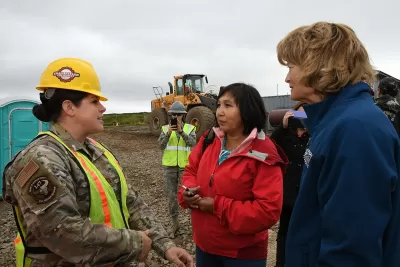
The village of Newtok, Alaska, is in the process of relocating to a new village site named Metarvik in what is considered a test case of climate change impacts. As resident Carolyn George say's, “There is no blueprint on how to do this relocation. We’re relocating the whole community to a whole different place, and we did not know how to do it. And it’s been taking too long — over 20 years, I think.”
Reporter Yereth Rosen, a reporter with the Alaska Beacon, writes, "While Newtok is the first Alaska village to relocate, others will follow. Even two decades ago, 31 communities were identified as facing imminent threats that would make their locations potentially unlivable in the near future. Of those, nearly half were planning or considering some form of relocation.
Next after Newtok to relocate entirely may be Kivaline, an Inupiat village on the Chukchi Sea coast that is facing numerous climate stressors along with rapid erosion. The community now has a new evacuation road, completed in 2021, that can better enable movement to a new site."
Read the full story: Relocation of eroding Alaska Native village seen as a test case

Study: New Orleans sea level rise is at 'point of no return'
Research shows that the city could be surrounded by water by the end of this century.
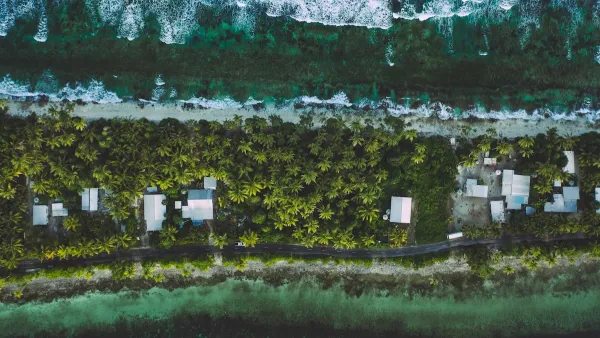
Sea Level Rise is Drowning This Pacific Island Nation; They Have a Plan
The nation of Tuvalu has created an ambitious plan to relocate its entire population and preserve key cultural and historic resources as rising seas threaten to wipe it out within three decades.

Rising Above: Innovative Solutions for Waikīkī’s Sea-Level Challenges
The University of Hawaiʻi at Mānoa’s award-winning Waikīkī sea-level rise adaptation project combines science, architecture, and community input to create scalable solutions for climate resilience and coastal flood mitigation.

Planetizen Federal Action Tracker
A weekly monitor of how Trump’s orders and actions are impacting planners and planning in America.

California plans to bury El Niño’s downpour
If the state plays its cards right, it may be able to store a billion acre-feet of El Niño’s water in aquifers.

Desperate measures: Advocates weigh draining Lake Powell to fill Colorado River
Draining the reservoir could reduce evaporation losses by a couple hundred thousand acre-feet.

Mamdani’s pied-à-terre tax survives legal challenge
A panel of judges found that the plaintiffs failed to demonstrate injury as a result of New York City's implementation of the tax.

Eastern Nebraska is running out of electricity
Data centers and electrification are straining eastern Nebraska’s grid, throttling economic development.

Seattle passes record-breaking transit services expansion
Proposition 1 will double the city’s transit tax to add 95,000 more bus trips and preserve 180,000 bus trips annually.

FREE Course: Walkable City 1: Why Walkability?
After describing his path towards focusing on walkability as the essence of good planning, Jeff Speck marches through his five principal reasons for making more walkable places.
Reinventing Malls: Planning Alchemy—Turning Gray Fields Into Gold
The course focuses on the opportunities and imperatives that shape reinvention of mall sites.


City of Rosemead
Rutgers University, Edward J. Bloustein School of Planning and Public Policy
One Hundred Miles
University of Michigan School for Environment and Sustainability (SEAS)
Hunter College, City University of New York (CUNY)
The Architects Foundation
City of Cambridge
Montrose County
The Pocatello Development Authority