A key commercial corridor connecting Oakland and Fremont in the East Bay Area is due for a dramatic transformation in the form of a new Bus Rapid Transit line.


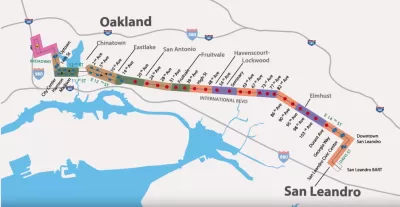
AC Transit will ramp up construction on a $204 million bus rapid transit line along International Boulevard in the East Bay Area, according to an article by Erin Baldassari. The 9.5-mile route will connect the San Leandro BART station to 20th Street and Broadway in Oakland, with buses arriving every seven minutes. The new line also includes "elevated platforms and more comfortable stations, its own travel lane and forward-facing cameras to ticket motorists who block its path," according to Baldassari.
As with most major transit investments, planners also have hopes that the project can be a catalyst for new investments and development along the corridor. And as with most catalytic projects, "some residents, community advocates and business owners fear the same economic development will only accelerate the displacement of Oakland and San Leandro’s most vulnerable residents and small businesses as rents rise throughout the region," according to Baldassari.
The feature-length article then tours several case studies from other cities, like Cleveland and San Francisco, to examine the question of who will benefit from the project.
FULL STORY: Oakland, San Leandro: Some fear ‘transformative’ rapid transit system coming to storied thoroughfare

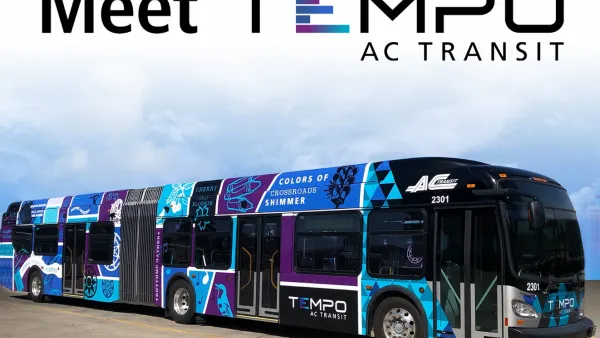
New, Fully Stocked Bus Rapid Transit Coming to the East Bay Area
Elevated stations, level boardings, dedicated lanes, camera enforcement of lanes—AC Transit's Tempo bus rapid transit line has it all.
East Bay BRT Project Receives $81 Million in Federal Grants
Don't confuse East Bay Rapid Transit with Bay Area Rapid Transit: one's a bus, the other heavy rail. But calling it a bus does not do justice to what will be the Bay Area's first bus rapid transit (BRT) line composed primarily of dedicated lanes.
BRT Boom in U.S.
A new study says that Los Angeles, Cleveland, Las Vegas, Eugene and Pittsburgh are leading the surge with the best bus rapid transit (BRT) systems in the nation.

The state-sanctioned urbicide of Austin
People don’t kill cities. Freeways do.

US to reduce Colorado River water deliveries to Mexico
A new Colorado Treaty amendment reduces Mexico’s Colorado River water allocation by 250,000 acre feet.

New Jersey’s second-largest city bans standalone data centers
Jersey City will continue to allow co-location facilities, such as those meant for research institutions that store their own data.

Amtrak not solely to blame for New Jersey commuter rail's unreliability, report finds
A new study from the Garden State Initiative found that NJ Transit’s budget grew 20% across a 4 year period, but reliability declined significantly over the same period.

EPA erases limits on planet-warming pollution from power plants
Under Monday’s plan, power plants would still have some limits on how much mercury, arsenic and other contaminants they can emit.

Phoenix announces new on-demand transit service, more frequent RAPID buses
Both new services will launch in October, and are part of Phoenix's Project Effective Access Solutions for Easing Congestion.

FREE Course: Walkable City 1: Why Walkability?
After describing his path towards focusing on walkability as the essence of good planning, Jeff Speck marches through his five principal reasons for making more walkable places.
Reinventing Malls: Planning Alchemy—Turning Gray Fields Into Gold
The course focuses on the opportunities and imperatives that shape reinvention of mall sites.

Eagle County Government
Harvard University Graduate School of Design
Nashville Planning Department
The Architects Foundation
University of Cincinnati Online
The Pocatello Development Authority
The Urban Renewal Agency of the City of Pocatello
Journal of the American Planning Association