The Virginia county of Arlington has written into law the ability to create shared streets as well as streets that prioritize pedestrians.



"The Arlington County Board adopted today proposed amendments to the Master Transportation Plan Street Element, incorporating two innovative changes: a new pedestrian priority street type — a car-free street that provides pedestrians access to adjacent buildings — and “shared streets” — for pedestrians, bicyclists and low speed vehicular traffic," according to a news release from the county of Arlington.
The new street variations are already included in sector plans for the Rosslyn and Courthouse areas, but the new amendments are also intended to inform future plans in other locations arounf the county. The news release explains the Rosslyn and Courthouse plans in more detail, however.
"Arlington is a varied community that puts an emphasis on various modes of travel – be it walking, biking, taking transit or driving," said Arlington County Board Chair Libby Garvey, as quoted in the release. "These street variations are very exciting and an important step in improving access and safety for the many residents, visitors and commuters that walk and bike around Arlington each and every day."
Read the full story: Board Acts for Pedestrian, Bicycle Access and Safety with More Street Types
Lake Shore Drive Proposal Inspires Debate
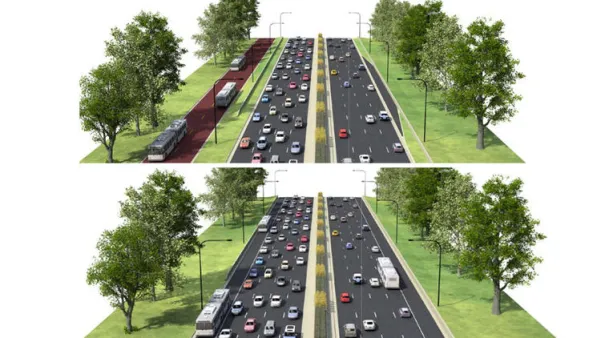
Take a car lane or widen Lake Shore Drive? That's the question facing state and local officials in Chicago.

‘Tempe Tomorrow’ Plans for Expected Population Growth
Tempe planners are preparing a General Plan update scheduled for voter approval in March 2024.

Sioux Falls Multi-Family Development Outpaces Transportation Improvements
Sioux Falls, South Dakota is undergoing a multi-family development boom. Residents are increasingly concerned about the traffic the development brings, according to local news reports.

Planetizen Federal Action Tracker
A weekly monitor of how Trump’s orders and actions are impacting planners and planning in America.

California plans to bury El Niño’s downpour
If the state plays its cards right, it may be able to store a billion acre-feet of El Niño’s water in aquifers.

Desperate measures: Advocates weigh draining Lake Powell to fill Colorado River
Draining the reservoir could reduce evaporation losses by a couple hundred thousand acre-feet.

Mamdani’s pied-à-terre tax survives legal challenge
A panel of judges found that the plaintiffs failed to demonstrate injury as a result of New York City's implementation of the tax.

Eastern Nebraska is running out of electricity
Data centers and electrification are straining eastern Nebraska’s grid, throttling economic development.

Seattle passes record-breaking transit services expansion
Proposition 1 will double the city’s transit tax to add 95,000 more bus trips and preserve 180,000 bus trips annually.

FREE Course: Walkable City 1: Why Walkability?
After describing his path towards focusing on walkability as the essence of good planning, Jeff Speck marches through his five principal reasons for making more walkable places.
Reinventing Malls: Planning Alchemy—Turning Gray Fields Into Gold
The course focuses on the opportunities and imperatives that shape reinvention of mall sites.

City of Rosemead
Rutgers University, Edward J. Bloustein School of Planning and Public Policy
One Hundred Miles
University of Michigan School for Environment and Sustainability (SEAS)
Hunter College, City University of New York (CUNY)
The Architects Foundation
City of Cambridge
Montrose County
The Pocatello Development Authority