Take a car lane or widen Lake Shore Drive? That's the question facing state and local officials in Chicago.


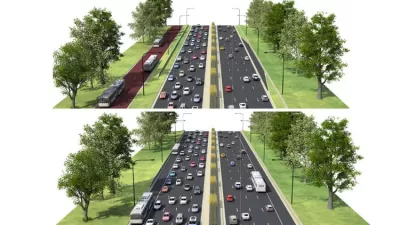
"Transportation officials are considering creating bus lanes on North Lake Shore Drive by either taking out a regular traffic lane in each direction or widening the roadway," reports Mary Wisniewski.
As Wisniewski notes, either option is potentially controversial. Divers won't want to lose a lane, and transit and neighborhood advocates don't want more space to go to drivers.
To prove the latter prediction correct, Yonah Freemark followed up on the news with a post about the "wishful thinking" of urban transportation planning.
"For American cities, highways are a drug," writes Freemark. "They’re expensive to acquire. They devastate healthy tissue and arteries, replacing previous modes of nourishment with destructive ones. They force the rest of the body to adapt to their needs, and they inflict pain on those nearby." Freemark references North Lake Shore Drive as exhibit number one in making that case.
Wisniewski provides more details of the potential project, like the still very long timeline for the project.
Neither proposal would become reality anytime soon — the ideas are among many being discussed as part of a long planning process for the reconstruction of Lake Shore Drive between Grand and Hollywood avenues by a project team made up of officials from the Illinois Department of Transportation, the Chicago Department of Transportation and the Chicago Park District. It will be years before the $2 billion to $3 billion reconstruction would take place.
FULL STORY: A future Lake Shore Drive could be wider, and have bus lanes

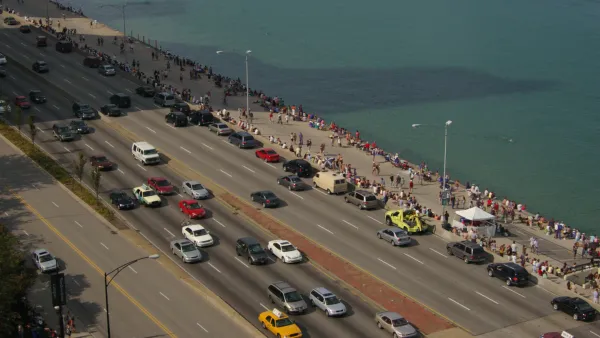
Bus Lanes, Desired by Advocates for Chicago's Lake Shore Drive Project, Back on the Table
After releasing a list of project alternatives that didn't include new bus lanes in the existing roadway, the Illinois Department of Transportation (IDOT) has changed its mind.
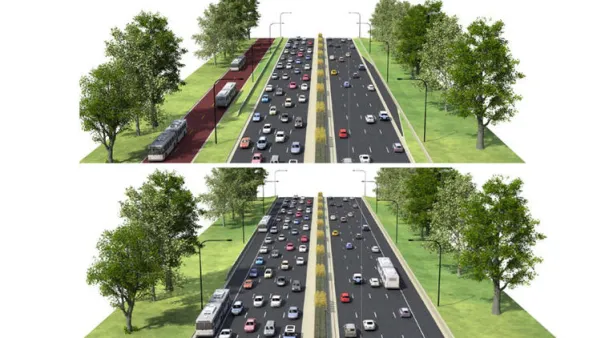
North Lake Shore Drive Redo Falls Short of Bus Priority Expectations
Strong criticisms of the project alternatives under consideration by the Illinois Department of Transportation for the closely watched North Lake Shore Drive project.
Chicago Planning Meeting Turns Against Cyclists, Walkability
This week, the Illinois DOT kicked off a set of public meetings to "redefine" Chicago's Lake Shore Drive. At the first meeting, a decidedly pro-car and anti-bicyclist sentiment crept into the comments.

The state-sanctioned urbicide of Austin
People don’t kill cities. Freeways do.

US to reduce Colorado River water deliveries to Mexico
A new Colorado Treaty amendment reduces Mexico’s Colorado River water allocation by 250,000 acre feet.

New Jersey’s second-largest city bans standalone data centers
Jersey City will continue to allow co-location facilities, such as those meant for research institutions that store their own data.

Amtrak not solely to blame for New Jersey commuter rail's unreliability, report finds
A new study from the Garden State Initiative found that NJ Transit’s budget grew 20% across a 4 year period, but reliability declined significantly over the same period.

EPA erases limits on planet-warming pollution from power plants
Under Monday’s plan, power plants would still have some limits on how much mercury, arsenic and other contaminants they can emit.

Phoenix announces new on-demand transit service, more frequent RAPID buses
Both new services will launch in October, and are part of Phoenix's Project Effective Access Solutions for Easing Congestion.

FREE Course: Walkable City 1: Why Walkability?
After describing his path towards focusing on walkability as the essence of good planning, Jeff Speck marches through his five principal reasons for making more walkable places.
Reinventing Malls: Planning Alchemy—Turning Gray Fields Into Gold
The course focuses on the opportunities and imperatives that shape reinvention of mall sites.

Eagle County Government
Harvard University Graduate School of Design
Nashville Planning Department
The Architects Foundation
University of Cincinnati Online
The Pocatello Development Authority
The Urban Renewal Agency of the City of Pocatello
Journal of the American Planning Association