Oslo sets ambitious goal for carbon emissions with a "Climate Budget." The budget is a sign of climate policies to come as the Paris climate agreement begins to take effect around the world.


With the Paris climate agreement set to take effect November 4th leaders from around the world are considering how they will take on the challenge of lowering their carbon emissions. According to an article in Next City by Jen Kinney, Norway's capital, Oslo, is looking to track its emissions in a first-of-its-kind, climate budget. "We’ll count carbon dioxide the same way as we count money," Vice Mayor, Robert Steen, told Reuters.
The budget is an aggressive one, "The Oslo Council had already agreed earlier in the year to halve Oslo’s emissions from 1.2 million tons of carbon dioxide in 1990 to 600,000 by 2020," Kinney reports. That pace would be well ahead of the one set by the Paris agreement and another first of its kind for the city.
Read the full story: Oslo Issues First, Ambitious “Climate Budget”

EPA Plans “Largest Deregulatory Action” in History
The agency plans to repeal a key 2009 rule that underpins the government’s authority to regulate greenhouse gas emissions.

LA’s Trees Absorb More Carbon Than Expected, But Can’t Do It Alone
A USC study finds that Los Angeles’ urban trees absorb more carbon than expected, but while they provide crucial environmental benefits, they cannot replace the urgent need for systemic emissions reductions.
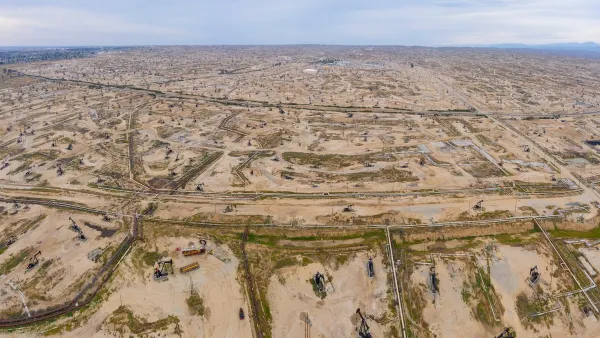
California County Approves Underground Carbon Storage Project
Kern County supervisors voted to support a carbon storage project that will inject climate-warming gases into a former oil and gas field.

Planetizen Federal Action Tracker
A weekly monitor of how Trump’s orders and actions are impacting planners and planning in America.

Amtrak, CN end decades-long dispute with eight-year agreement
The new operating agreement establishes an updated framework for the companies to work together, including processes to resolve disputes.

Judges permit Denver to divert 77,000 acre feet from the Colorado River for reservoir expansion
Overuse and climate change have caused the Colorado River’s water levels to plummet.

Idaho may see an 18% drop in federal surface transit funding — the largest estimated cut in the US
Transit systems in rural communities are much more reliant on federal funding to provide their services.

How ‘post-disaster gentrification’ alters neighborhoods after natural calamities
After hurricanes, fires or other calamities, the original residents of a community are often replaced by younger, wealthier residents.

Maryland local governments examine if they should have more power to raise property taxes
Maryland’s housing market is out of reach for the majority of moderate-income residents.

FREE Course: Walkable City 1: Why Walkability?
After describing his path towards focusing on walkability as the essence of good planning, Jeff Speck marches through his five principal reasons for making more walkable places.
Reinventing Malls: Planning Alchemy—Turning Gray Fields Into Gold
The course focuses on the opportunities and imperatives that shape reinvention of mall sites.

Harvard University Graduate School of Design
KFH Group Inc.
Greater Baltimore Committee
The Architects Foundation
University of Cincinnati Online
The Pocatello Development Authority
The Urban Renewal Agency of the City of Pocatello