Chicago suburban residents were long more conservative than the average Illinois voter but, over the last two decades, that has changed.


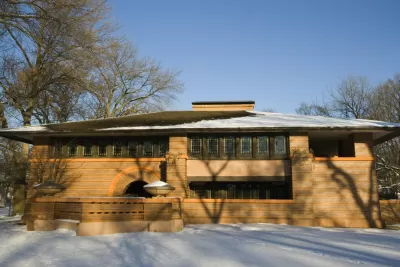
Chicago's suburbs are becoming increasingly Democratic, writes Daniel Kay Hertz in a post to his blog. Using information from Illinois Election Data, Hertz has put together a measure of relative preference that compares regions of the state to the state overall.
To get a sense of the trends in different parts of the state, the data has been broken down into four parts, "The city of Chicago; suburban Cook County; the suburban collar counties (which, in this version, include everything in Chicago’s media market); and the rest of the state."
While each region has seen changes, "The Cook County suburbs were completely transformed, moving from about 7 points more Republican than the state as a whole, to being 7 points more Democratic." This is almost certainly tied to the movements of many African Americans out of the city into the nearby suburbs, but that only tells part of the story of a changing state that while voting solidly for every Democratic president since 1988 is currently represented by a Republican Governor and one Republican Senator.
Hertz also speculates that more similar political beliefs in the close-in suburbs may lead to "greater regional planning." We shall see.
Read the full story: Chicago’s newly Democratic suburbs
Black Chicagoans Segregated, Regardless of Income
Latino Chicagoans are more likely to live in diverse neighborhoods than whites or blacks do.
Denser, More Urban Suburbs
Social changes in America relating to work, demographics and the family are changing the face of suburbs around the US.
If Housing Affordability Is Top Concern, Let Metro Regions Sprawl
Research from BuildZoom, a San Francisco-based contractors' website, shows that housing affordability increases with a region's ability to build outwards, as opposed to upwards. Densification largely has not accompanied efforts to curb sprawl.

Planetizen Federal Action Tracker
A weekly monitor of how Trump’s orders and actions are impacting planners and planning in America.

California plans to bury El Niño’s downpour
If the state plays its cards right, it may be able to store a billion acre-feet of El Niño’s water in aquifers.

Desperate measures: Advocates weigh draining Lake Powell to fill Colorado River
Draining the reservoir could reduce evaporation losses by a couple hundred thousand acre-feet.

Mamdani’s pied-à-terre tax survives legal challenge
A panel of judges found that the plaintiffs failed to demonstrate injury as a result of New York City's implementation of the tax.

Eastern Nebraska is running out of electricity
Data centers and electrification are straining eastern Nebraska’s grid, throttling economic development.

Seattle passes record-breaking transit services expansion
Proposition 1 will double the city’s transit tax to add 95,000 more bus trips and preserve 180,000 bus trips annually.

FREE Course: Walkable City 1: Why Walkability?
After describing his path towards focusing on walkability as the essence of good planning, Jeff Speck marches through his five principal reasons for making more walkable places.
Reinventing Malls: Planning Alchemy—Turning Gray Fields Into Gold
The course focuses on the opportunities and imperatives that shape reinvention of mall sites.

City of Rosemead
Rutgers University, Edward J. Bloustein School of Planning and Public Policy
One Hundred Miles
University of Michigan School for Environment and Sustainability (SEAS)
Hunter College, City University of New York (CUNY)
The Architects Foundation
City of Cambridge
Montrose County
The Pocatello Development Authority