Bike lanes are considered a social intervention, and not directly medically related. But they are also proving to have an obviously positive effect on public health outcomes.


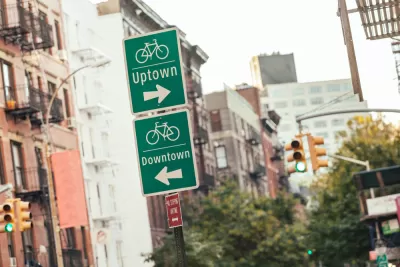
An article in Reuters shares news of a new economic assessment, completed by Dr. Babak Mohit of the Mailman School of Public Health at Columbia University in New York, among other researchers. The study was published in September by Injury Prevention.
The assessment analyzed the bike lane investments by New York City, finding that for "Every $1,300 New York City invested in building bike lanes in 2015 provided benefits equivalent to one additional year of life at full health over the lifetime of all city residents."
The article notes that economists have used the quality-adjusted life year (QALY) to measure the impact of public health investments of health interventions like dialysis ($1,300 per QALY) and vaccines (~$100 per QALY). As the research shows, bike lanes perform surprisingly well as a public health investment.
That's a better return on investment than some direct health treatments, like dialysis, which costs $129,000 for one quality-adjusted life year, or QALY.
FULL STORY: Bike lanes are a sound public health investment

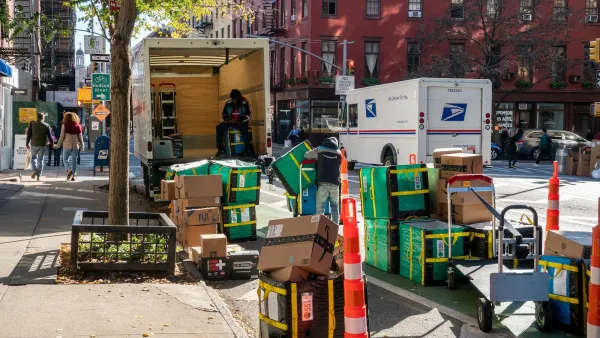
Report: 75% of NYC warehouses are in 'disadvantaged communities'
Low-income New Yorkers are 1.2 times more likely to live within half a mile of a warehouse.
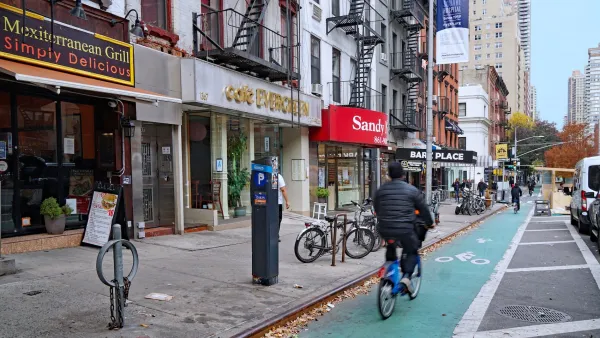
Study: Protected bike lanes increase Citi Bike rides by nearly 400 rides a month
An analysis of millions of NYC bike share rides reveals that only protected bike lanes have a 'statistically significant' increase in ridership.

NYC Congestion Pricing Revenue Will Fund up to 1,000 Hybrid Refrigerated Trucks
Traffic to the Hunts Point Produce Market causes increased rates of asthma in surrounding neighborhoods.

Planetizen Federal Action Tracker
A weekly monitor of how Trump’s orders and actions are impacting planners and planning in America.

The state-sanctioned urbicide of Austin
People don’t kill cities. Freeways do.

US to reduce Colorado River water deliveries to Mexico
A new Colorado Treaty amendment reduces Mexico’s Colorado River water allocation by 250,000 acre feet.

5 New England states march closer to 800 megawatt wind energy project
Securing federal approval for the project may be complicated under the Trump administration, which has historically been hostile towards domestic wind power.

Baltimore to break ground on $50 million Transit Priority Project
The project will bring faster bus trips, safer streets and better bike connections to Baltimore.

Airbnb launches $250 million 'last-dollar financing' housing accelerator, makes first investment in Austin
The company will put $6.4 million towards affordable housing development in Texas’ capital.

FREE Course: Walkable City 1: Why Walkability?
After describing his path towards focusing on walkability as the essence of good planning, Jeff Speck marches through his five principal reasons for making more walkable places.
Reinventing Malls: Planning Alchemy—Turning Gray Fields Into Gold
The course focuses on the opportunities and imperatives that shape reinvention of mall sites.

Eagle County Government
Harvard University Graduate School of Design
Nashville Planning Department
The Architects Foundation
University of Cincinnati Online
The Pocatello Development Authority
The Urban Renewal Agency of the City of Pocatello
Journal of the American Planning Association