With more than 600,000 daily commuters passing through, Penn Station is one of the busiest transit halls in the Western Hemisphere. Finally, there's a plan in place to make necessary repairs without making the commute even more unbearable.



"The Farley building would be a home for both Amtrak and, in a break with past proposals, the Long Island Rail Road, which should bring some relief to the congestion at Penn Station, which also houses New Jersey Transit," adds Bagli.
As noted at the outset of the article, the challenge of fixing Pennsylvania station has stymied governors and mayors for 25 years. The project will require a lot of private partners. So far, Gov. Cuomo has selected developers Related Companies, Vornado Realty and Skanska AB to complete the $1.6 billion plan. "The developers will pay $600 million for the rights to the Farley project. Empire State Development, a state agency, and Amtrak, which owns Penn Station, will soon solicit bids for overhauling the station," according to Bagli.
In a separate article, Amy Plitt summarizes the Penn Station and Farley building development proposals:
Today, Governor Andrew Cuomo unveiled plans for the forthcoming Pennsylvania Station-Farley Complex, along with announcing the developers and builders who will collaborate on the project. The plans call for a brand new, 255,000-square-foot train hall, which will accommodate both Amtrak and Long Island Rail Road passengers, that’s scheduled to be completed by the end of 2020. (Yes, you read that date right.)
Plitt also provides a list of big takeaways from the governor's announcement—recommended reading for the details and scope of the project.
Read the full story: Cuomo’s Vision for Revamped Penn Station: New Home for Amtrak and L.I.R.R.
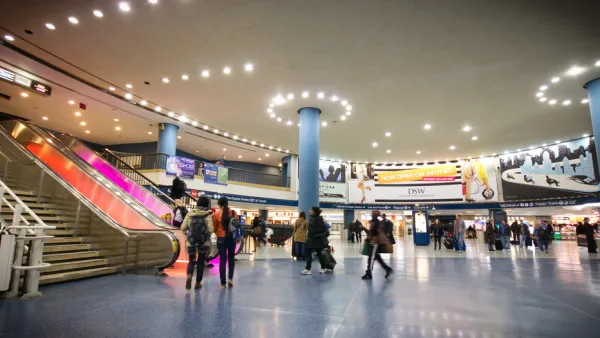
Early Criticism for Gov. Cuomo's Penn Station Plans
The initial reviews are in for Governor Andrew Cuomo's proposal to expand and improve Penn Station. The consensus so far: the plan doesn't go far enough.
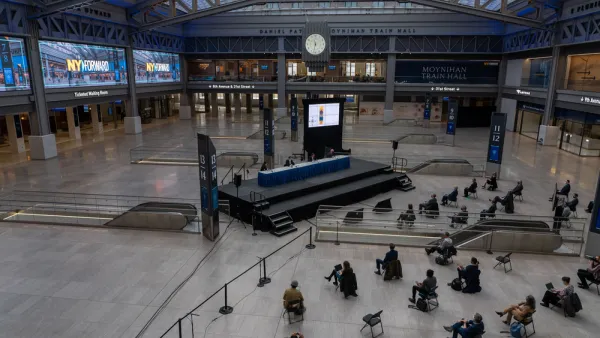
New York's Moynihan Train Hall Opens to the Public
The spacious, glass-ceilinged hall brings much-needed breathing room to the nation's busiest train station.

In New York's Next Penn Station, Function Does Not Always Follow Form
Some of the time and money invested in the visually spectacular Moynihan Station should have been spent looking at how well it actually works for commuters, writes Alon Levy.

Planetizen Federal Action Tracker
A weekly monitor of how Trump’s orders and actions are impacting planners and planning in America.

California plans to bury El Niño’s downpour
If the state plays its cards right, it may be able to store a billion acre-feet of El Niño’s water in aquifers.

Desperate measures: Advocates weigh draining Lake Powell to fill Colorado River
Draining the reservoir could reduce evaporation losses by a couple hundred thousand acre-feet.

Los Angeles just elected an urban planner as its mayor
Transportation analysts are optimistic that Raman will be more aggressive in addressing transit issues than Bass.

Mamdani’s pied-à-terre tax survives legal challenge
A panel of judges found that the plaintiffs failed to demonstrate injury as a result of New York City's implementation of the tax.

Eastern Nebraska is running out of electricity
Data centers and electrification are straining eastern Nebraska’s grid, throttling economic development.

FREE Course: Walkable City 1: Why Walkability?
After describing his path towards focusing on walkability as the essence of good planning, Jeff Speck marches through his five principal reasons for making more walkable places.
Reinventing Malls: Planning Alchemy—Turning Gray Fields Into Gold
The course focuses on the opportunities and imperatives that shape reinvention of mall sites.

City of Rosemead
Rutgers University, Edward J. Bloustein School of Planning and Public Policy
One Hundred Miles
University of Michigan School for Environment and Sustainability (SEAS)
Hunter College, City University of New York (CUNY)
The Architects Foundation
City of Cambridge
Montrose County
The Pocatello Development Authority