The names and faces occupying decision-making positions in the Capital Area Metropolitan Planning Organization do not reflect the names and faces of the people they are meant to represent.



Angie Schmitt shares news of a recently released report [pdf] examining the gender, race, and geography of decision-making boards represented in the Austin region’s Capital Area Metropolitan Planning Organization (CAMPO).
Jay Crossley completed the study, with crowdfunding to support the project, and arrived at an unsurprising finding: "women, people of color, and urban residents are significantly underrepresented at CAMPO — with potentially profound consequences for transportation policy."
Schmitt shares several of the visualizations from the report, to illustrate the massive disconnect between CAMPO's boards and the populations they represent. Crossley promises to explore question of how much the skewed representation affects transportation policy in the second phase of the project.
FULL STORY: How Unrepresentative Is Your Regional Planning Agency?

Big Expansion Approved for Austin-Area Highway
The Transportation Policy Board of the Capital Area Metropolitan Planning Organization approved a big spending increase for a project to widen U.S. Highway 183.
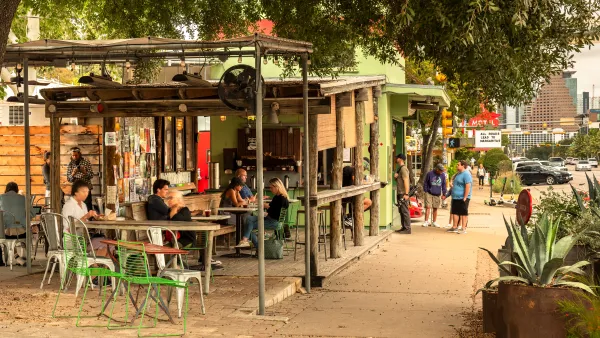
Large projects near Austin's light rail must include affordable housing
Elsewhere in the city, developers can pay into a city bank account for affordable housing rather than providing the required affordable units within their projects.
The new Texas law declawing NIMBYs
State lawmakers gutted an old Jim Crow-era state law that required a city council supermajority to approve a new housing development if neighbors petitioned the proposal.

Planetizen Federal Action Tracker
A weekly monitor of how Trump’s orders and actions are impacting planners and planning in America.

The state-sanctioned urbicide of Austin
People don’t kill cities. Freeways do.

US to reduce Colorado River water deliveries to Mexico
A new Colorado Treaty amendment reduces Mexico’s Colorado River water allocation by 250,000 acre feet.

Mamdani overhauls NYC's Vision Zero plan with 100 new policy goals
The overhaul aims to reduce traffic deaths and make streets safer for pedestrians, cyclists and drivers through lower speed limits, new safety infrastructure and more.

Amtrak not solely to blame for New Jersey commuter rail's unreliability, report finds
A new study from the Garden State Initiative found that NJ Transit’s budget grew 20% across a 4 year period, but reliability declined significantly over the same period.

EPA erases limits on planet-warming pollution from power plants
Under Monday’s plan, power plants would still have some limits on how much mercury, arsenic and other contaminants they can emit.

FREE Course: Walkable City 1: Why Walkability?
After describing his path towards focusing on walkability as the essence of good planning, Jeff Speck marches through his five principal reasons for making more walkable places.
Reinventing Malls: Planning Alchemy—Turning Gray Fields Into Gold
The course focuses on the opportunities and imperatives that shape reinvention of mall sites.

Eagle County Government
Harvard University Graduate School of Design
Nashville Planning Department
The Architects Foundation
University of Cincinnati Online
The Pocatello Development Authority
The Urban Renewal Agency of the City of Pocatello
Journal of the American Planning Association