Planning for the first human occupied martian cities is taking its next big step with three 3D-printed test colonies planned to be erected in the Mojave Desert.


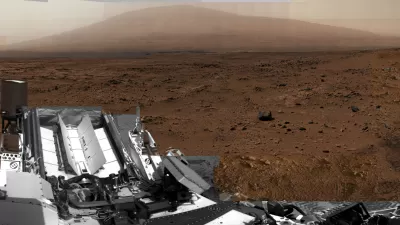
Thanks to a Kickstarter funded project, planners, architects, engineers, and others will now have the opportunity to develop what could become prototypes for future martian cities. Vas Panagiotopoulos of Quartz reports that a multi-day workshop put on by the Mars City Foundation this September at the University of Southern California will invite innovators to plan for cities that could accommodate up to 1,000 people. The project is the brainchild of architect and "marschitect" Vera Mulyani.
The workshop, whose speakers include Jim Erickson, project manager of NASA’s Mars Exploration Rover, and Madhu Thangavelu, a professor at the Viterbi School of Engineering, will also be attended by Apollo 11 pilot Buzz Aldrin.
... Mulyani says her team’s goal is to look far ahead, to examine “what happens after the first city, what happens after we have a base.” She also sees the purity of Mars as an opportunity to think long-term, something we didn’t do (and arguably still aren’t doing) on Earth.
Panagiotopoulos reports that the Mars City Design team will select three city-design proposals from among 25 finalists to 3D print as test runs in the Mojave desert. The finalists include projects that focus on vertical farming, an indoor river system and a system that uses elements in martian soil to create oxygen, water, energy, and nutrition.
Read the full story: The future of Mars will be 3D-printed in the Mojave Desert
How Gaming Can Revolutionize Planning
The new game Block’Hood seeks to illustrate and educate about the connection between sustainability and social and economic needs in city and neighborhood building.

Should USC Axe Its Unique Planning Doctoral Program?
Dr. Clement Lau, a Los Angeles County Planner, describes what the threatened USC Doctor of Policy, Planning, and Development (DPPD) program meant to him and why he thinks it's worth saving.
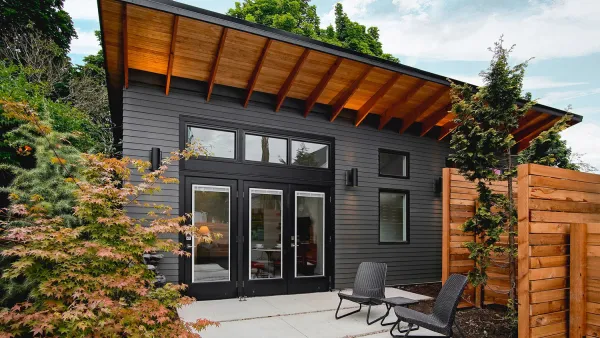
Los Angeles County gained more than 10,000 ADUs in 2025 — and barely made a dent in its housing goals
A new study warns that the burst in ADU development will not be enough to remedy Los Angeles’ affordable housing gap.

Planetizen Federal Action Tracker
A weekly monitor of how Trump’s orders and actions are impacting planners and planning in America.

Eastern Nebraska is running out of electricity
Data centers and electrification are straining eastern Nebraska’s grid, throttling economic development.

Study reveals best places in the U.S. for cycling, walking
New research from Streetlight Data examines bicycle and pedestrian miles per capita in the 100 largest U.S. cities by population.

DSA members accuse Mamdani of 'abandoning values' over housing redevelopment
New York City's mayor plans to replace about 2,000 units of public housing with private, mixed-income housing.

All sides of BRT debate unhappy with CDOT’s most recent move
The Colorado Department of Transportation is no longer considering center-running bus lanes for Colorado Boulevard.

Massachusetts bogs generate both power, and cranberries
Putting solar panels above farmland is one way Massachusetts is advancing toward its goal of net-zero carbon emissions by 2050.

FREE Course: Walkable City 1: Why Walkability?
After describing his path towards focusing on walkability as the essence of good planning, Jeff Speck marches through his five principal reasons for making more walkable places.
Reinventing Malls: Planning Alchemy—Turning Gray Fields Into Gold
The course focuses on the opportunities and imperatives that shape reinvention of mall sites.

City of Rosemead
Rutgers University, Edward J. Bloustein School of Planning and Public Policy
One Hundred Miles
University of Michigan School for Environment and Sustainability (SEAS)
Hunter College, City University of New York (CUNY)
The Architects Foundation
City of Cambridge
The Pocatello Development Authority
The Urban Renewal Agency of the City of Pocatello