The new game Block’Hood seeks to illustrate and educate about the connection between sustainability and social and economic needs in city and neighborhood building.


Jose Sanchez of the University of Southern California’s School of Architecture has produced Block’Hood, a neighborhood building simulator, that he hopes will attract both gamers and practitioners. Marcus Fairs writes in Dezeen that the new simulator, released on March 10th and available on Steam, challenges players to balance the needs for inputs with the resultant outputs.
"The game is based on concepts of ecology and entropy," Sanchez said. "Blocks require inputs to survive. A tree might need water, but an apartment will need electricity, water and public space."
"All blocks in the game have specific needs, but also produce specific outputs. By balancing the inputs and outputs of blocks in the game, a player understands the complex interdependence among city units."
Fairs writes that the game, and urban development games similar to it, may one day play a role in how our cities are shape din the future. Gaming can be used to encourage public participation and help residents understand the complexities of the urban environment. So far, Block'Hood has received pretty positive reviews on Steam where it is available for purchase and download.
Read the full story: Video games will become "new tools" to solve architecture's global challenges


Friday Fun: CityLab Picks the Best Games of 2020
In the year of stay-at-home orders, people turned to old and new games to stay sane and stay connected.
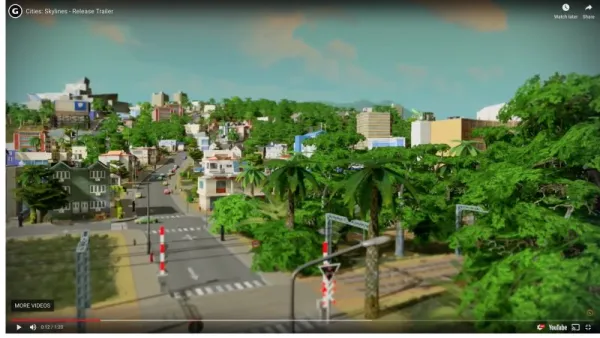
Top Urban City Building Games in 2019
A middle schooler reviews the top three city building games on the market in 2019.

How Do We Plan For Cities on Mars?
Planning for the first human occupied martian cities is taking its next big step with three 3D-printed test colonies planned to be erected in the Mojave Desert.

Planetizen Federal Action Tracker
A weekly monitor of how Trump’s orders and actions are impacting planners and planning in America.

California plans to bury El Niño’s downpour
If the state plays its cards right, it may be able to store a billion acre-feet of El Niño’s water in aquifers.

Chicago breaks ground on $3 billion megadevelopment
The new neighborhood, titled Foundry Park, will one day host 3,700 residences.

California High-Speed Rail Authority CEO resigns after $600,000 scandal
Under Ian Choudri, the authority used taxpayer dollars to fund first class flights and trips to nightclubs.

Want to study the Missouri River? Soon, you may need unanimous approval from 10 states
Legislation would require 10 governors’ permission to study or build projects moving water outside the basin.

Desperate measures: Advocates weigh draining Lake Powell to fill Colorado River
Draining the reservoir could reduce evaporation losses by a couple hundred thousand acre-feet.

FREE Course: Walkable City 1: Why Walkability?
After describing his path towards focusing on walkability as the essence of good planning, Jeff Speck marches through his five principal reasons for making more walkable places.
Reinventing Malls: Planning Alchemy—Turning Gray Fields Into Gold
The course focuses on the opportunities and imperatives that shape reinvention of mall sites.

City of Rosemead
Rutgers University, Edward J. Bloustein School of Planning and Public Policy
One Hundred Miles
Hunter College, City University of New York (CUNY)
The Architects Foundation
University of Cincinnati Online
City of Cambridge
Montrose County
The Pocatello Development Authority