The New York MTA has chosen the "remove-the-band-aid-quickly" strategy for its plans to repair the L Train line from Brooklyn to Manhattan.


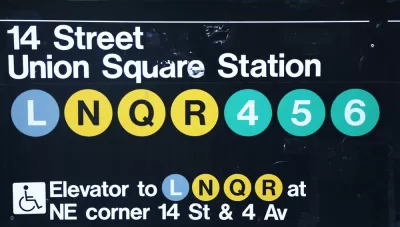
Emma G. Fitzsimmons reports: "The Metropolitan Transportation Authority plans to close a tunnel that carries the L train, one of New York City’s most crowded subway lines, creating what officials acknowledge will be among the largest disruptions in the transit system’s history."
The threat of the closures has been lingering for a long time, though its doubtful the news about the closures brings any relief. In May, the New York Daily News described the whole situation when officials were considering one of two options for the closures. The announcement on Monday effectively ends the debate, and chooses the complete closure alternative over an option that would have allowed the operation of limited service over a three-year period.
"After considering two proposals for shutting down the L tunnel, the authority decided on the 18-month closing instead of a partial three-year shutdown that would have allowed some trains to continue running," explains Fitzsimmons.
As for details of exactly what parts of the L Train will be effected, Fitzsimmons adds this: "L trains will continue to operate in Brooklyn between the Williamsburg and Canarsie neighborhoods, but will not run between the Eighth Avenue stop in Manhattan and the Bedford Avenue station in Brooklyn. All five L train stops in Manhattan will close, along with the tunnel. About 225,000 riders now take the L train across the East River each day."
Read the full story: L Train Will Shut Down Between Manhattan and Brooklyn in ’19 for 18 Months
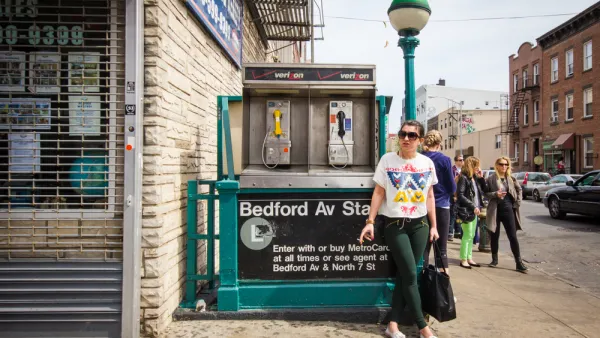
New Yorkers Bracing for L Train Closures
Two alternatives for repairs on the New York subway's L Train line will have severe consequences for 225,000 riders who cross the East River daily.
First Weekend of L Train Slowdown Could Have Been Worse
The long awaited repair work on the L Train between Brooklyn and Manhattan launched over the weekend.
Breaking: Gov. Cuomo Cancels L Train Closure
Surprise, shocking news from New York City, as Governor Andrew Cuomo steps in at the 11th hour to change course on the highly anticipated (and dreaded) L Train closure scheduled to begin later this year.

Planetizen Federal Action Tracker
A weekly monitor of how Trump’s orders and actions are impacting planners and planning in America.

California plans to bury El Niño’s downpour
If the state plays its cards right, it may be able to store a billion acre-feet of El Niño’s water in aquifers.

Desperate measures: Advocates weigh draining Lake Powell to fill Colorado River
Draining the reservoir could reduce evaporation losses by a couple hundred thousand acre-feet.

Los Angeles just elected an urban planner as its mayor
Transportation analysts are optimistic that Raman will be more aggressive in addressing transit issues than Bass.

Mamdani’s pied-à-terre tax survives legal challenge
A panel of judges found that the plaintiffs failed to demonstrate injury as a result of New York City's implementation of the tax.

Eastern Nebraska is running out of electricity
Data centers and electrification are straining eastern Nebraska’s grid, throttling economic development.

FREE Course: Walkable City 1: Why Walkability?
After describing his path towards focusing on walkability as the essence of good planning, Jeff Speck marches through his five principal reasons for making more walkable places.
Reinventing Malls: Planning Alchemy—Turning Gray Fields Into Gold
The course focuses on the opportunities and imperatives that shape reinvention of mall sites.

City of Rosemead
Rutgers University, Edward J. Bloustein School of Planning and Public Policy
One Hundred Miles
University of Michigan School for Environment and Sustainability (SEAS)
Hunter College, City University of New York (CUNY)
The Architects Foundation
City of Cambridge
Montrose County
The Pocatello Development Authority