At their July 7 meeting, the Caltrain Joint Powers Board, a 3-county body that administers the crowded San Jose-to-San Francisco commuter rail line, unanimously approved $1.25 billion in contracts to rail and infrastructure firms for electrification.


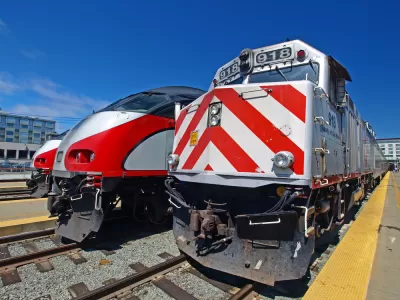
The 55-mile Caltrain commuter line runs 92 weekday trains connecting the three premier hubs of Silicon Valley: San Francisco, the Peninsula (home to Facebook in Menlo Park and Google in Mountain View), and San Jose. It has seen ridership escalate rapidly since it introduced its so-called 'baby bullet' trains in 2004. It's now ready to take the next big step: convert from diesel power to overhead electrification.
If, and that's a big 'if,' the funding falls into place, electric service could begin on 51 miles of the line in 2020. "The board’s unanimous vote highlighted its optimism in Caltrain’s ability to secure the remainder of its necessary funding," observed Samantha Weigel for the Daily Journal.
"Included in the contract is an order for 96 rail vehicles, with an option to buy an additional 20," reports Roger Rudick, Streetsblog SF editor.
According to the Caltrain staff report [PDF] issued during the meeting, the new electric multiple unit (EMU) trains will be built by Stadler, a Swiss company, and stringing the overhead wire and additional infrastructure for the electrification of the tracks will be done by the British firm Balfour Beatty.
Caltrain was the first railroad in the country to be granted a waiver by the Federal Railroad Administration (FRA) to use 'European-style' EMUs on tracks where diesel trains also operate. "For decades, the Federal Railroad Administration had effectively banned modern European trains from American mainline rail networks," according to Next City (posted here).
"What will it mean for commutes between San Francisco and the South Bay?" asks Ruddick.
In a previous post, Caltrain official Casey Fromson said because of the improved acceleration, a trip that diesel baby bullets do in 60 minutes will take 45 with a train of EMUs. Electric trains are also quieter, more reliable and non-polluting."
Funding not all in place
Electrification is one of two projects that compose the Caltrain Modernization Program.
“The total program is $2 billion. That includes money for the advanced signal system [aka positive train control] which we’re already installing today,” said Jayme Ackemann, spokeswoman for Caltrain. [See project status (PDF)]. “But the $1.25 billion is the lion’s share for electrification.”
"However, the regional local transit agency doesn’t yet have $1.3 billion in necessary funding — the gap includes contributions from high-speed rail as well as a federal grant it applied for last year that staff hopes to hear about by the year’s end," reports the Daily Journal's Weigel.
The agreements include provisions for both [Balfour Beatty and Stadler] to begin designing their projects with only a portion of funding, with acknowledgment they must wait until Caltrain secures the remainder before actually commencing construction.
Immediately following approval of the contracts, the board went on to enter into an agreement with the California High-Speed Rail Authority [PDF] for the state to provide a total of $713 million toward electrifying the corridor they may share. [See 2012 post on regional agreement to fund electrification].
However, not even the state funding is in place. Legislation introduced last month to distinguish funds for 'bookend projects,' including Caltrain electrification, from funds for the mainline construction which have yet to be authorized, is in the Senate Appropriations Committee.
Caltrain anticipates hearing whether its application for a $647 federal grant [for a Federal full funding grant agreement from the Federal Transit Administration] is approved later this year.
Weigel reports on opponents to the project, including the Town of Atherton in southern San Mateo County, "which alleges the environmental review of electrification is lacking and the impacts of bringing high-speed rail to the corridor would be overly burdensome."
The town, which had "the nation’s most expensive zip code" in 2014, and neighbor Menlo Park filed the first lawsuit against the High-Speed Rail Authority in 2009.
Caltrain, among the shortest lines in the country with only 77 miles including the Gilroy extension, had the seventh highest ridership among U.S. commuter rail lines last year. However, commute-hour trains are packed in both directions, resulting in it being the third highest ridership per mile, below only New York MTA's LIRR and Metro-North.
Read the full story: It’s a Go for Caltrain Electrification

Funds Flow to Caltrain Electrification Project
Nothing comes easy for high-speed rail, or anything connected to it, as the agency that runs Caltrain learned in February. But now that a $647 million federal grant has been approved, $713 million in state bond funds will be directed to the project.
Train Buffs: Do You Know What a ZEMU Is?
In addition to commuter trains hauled by an electric or diesel-powered locomotive, there are EMUs and DMUs, and come 2021, for the first time in North America, there should be a ZEMU thanks in part to a $30 million California transportation grant.

Rail Electrification: Caltrain adds BEMUs to its EMU Order
Caltrain, the San Francisco-to-San Jose commuter railroad, plans to begin electrified operation next year on its 49-mile mainline. A 28-mile extension south to Gilroy would continue to be served by diesel trains, with one train powered by battery.

Planetizen Federal Action Tracker
A weekly monitor of how Trump’s orders and actions are impacting planners and planning in America.

Amtrak, CN end decades-long dispute with eight-year agreement
The new operating agreement establishes an updated framework for the companies to work together, including processes to resolve disputes.

Judges permit Denver to divert 77,000 acre feet from the Colorado River for reservoir expansion
Overuse and climate change have caused the Colorado River’s water levels to plummet.

Philadelphia to invest $2 billion into upgrading city airports as PHL places last in customer satisfaction
Modernizations to Philadelphia's airports will include baggage system upgrades and a new automated parking garage guidance system.

The LA housing policies making developers turn away from the city
Despite LA’s housing shortage, developers say the city’s "mansion-tax" and pandemic-era policies make it an unappealing place to build housing.

New density bill would require 7 California cities to establish regional transit hubs
The bill would also require major cities in California to permit high-rise residential buildings.

FREE Course: Walkable City 1: Why Walkability?
After describing his path towards focusing on walkability as the essence of good planning, Jeff Speck marches through his five principal reasons for making more walkable places.
Reinventing Malls: Planning Alchemy—Turning Gray Fields Into Gold
The course focuses on the opportunities and imperatives that shape reinvention of mall sites.

City of Wisconsin Rapids
Harvard University Graduate School of Design
KFH Group Inc.
The Architects Foundation
University of Cincinnati Online
The Pocatello Development Authority
The Urban Renewal Agency of the City of Pocatello