The leadership at the city of Seattle has noticed that the people representing neighborhoods on the city's district councils don't reflect the population of the city.


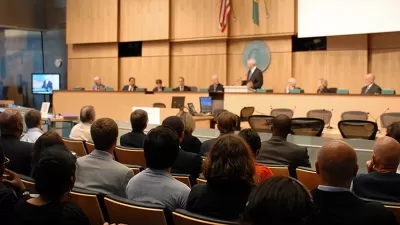
Seattle Department of Neighborhood Director Kathy Nyland "is the driving force behind a major policy shift that [Mayor Ed] Murray is set to announce today," according to an article by Josh Feit. That is, Mayor Murray will propose replacing the district council system with a proposed "Community Involvement Commission."
Testifying in front the city council last month where, presenting data that showed a discrepancy between who’s on the city’s 13 community councils (older, white, homeowners) versus who lives in the city (median age 36, majority renters, and a 34 percent nonwhite population), Nyland said the community councils represented a “narrow, niche,” and concluded, “they don’t work for everyone [and] it’s unclear that the existing district council system is sufficiently flexible to meaningfully serve as a voice for all Seattle residents.”
According to Feit, the policy proposal would "retool the Department of Neighborhood’s approach to community outreach so that community input into city policy is driven by a more inclusive formula than the current model where district councils are the default voice on neighborhood policy." The article includes examples of how that would work—and a description of the potential political resistance the proposal could encounter.
Read the full story: Plastic Bag Ban Noncompliant, District Councils Not Working

Mandatory Housing Affordability Details Released in Seattle
Seattle has released the long-awaited environmental impact statement for the Mandatory Housing Affordability program—a final step in the Housing Affordability and Livability Agenda process launched by former Mayor Ed Murray.

How Seattle Is Curbing the Power of Neighborhood Groups
In Seattle, City Hall wants to open the neighborhood planning process to new demographics. The changes have rattled traditional neighborhood councils.

Seattle's New Updated Pedestrian Master Plan Includes $22 Million for Sidewalks
The promised update for the city of Seattle's Pedestrian Master Plan was released to the public last week.

Desperate measures: Advocates weigh draining Lake Powell to fill Colorado River
Draining the reservoir could reduce evaporation losses by a couple hundred thousand acre-feet.

Eastern Nebraska is running out of electricity
Data centers and electrification are straining eastern Nebraska’s grid, throttling economic development.

Move over, LA: St. Louis gears up for Olympics, invests millions in downtown redevelopment
The Missouri city will host the 2028 Olympic soccer group stage and knockout matches.

Mass. votes against statewide minimum lot size for single-family homes
Over 2 million residents voted on Question 7; it was decided by just over 30,000 votes.

Maryland’s $15 billion bridge project gains key approval
The Maryland Transit Authority said the project will create over 60,000 jobs and add $23 billion to the local economy.

‘No clear next steps’ for Chicago's permanent festival grounds
Eleventh Ward Ald. Nicole Lee has suggested Soldier Field as a possible location for the permanent event space.

FREE Course: Walkable City 1: Why Walkability?
After describing his path towards focusing on walkability as the essence of good planning, Jeff Speck marches through his five principal reasons for making more walkable places.
Reinventing Malls: Planning Alchemy—Turning Gray Fields Into Gold
The course focuses on the opportunities and imperatives that shape reinvention of mall sites.

City of Rosemead
Rutgers University, Edward J. Bloustein School of Planning and Public Policy
One Hundred Miles
University of Michigan School for Environment and Sustainability (SEAS)
Hunter College, City University of New York (CUNY)
The Architects Foundation
City of Cambridge
Montrose County
The Pocatello Development Authority