Streetsblog USA shares insights into a new study published by the Transportation Research Board finding that most park-and-ride facilities built by transit agencies waste money and land.


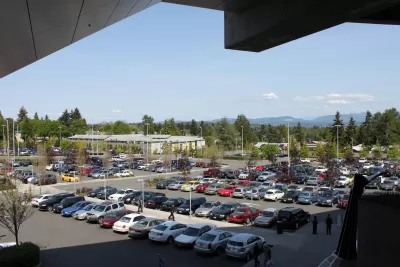
Angie Schmitt explains new research by Lisa Jacobson and Rachel Weinberger, who surveyed 37 American transit agencies about park-and-ride facilities.Their findings: "despite the expense of park-and-rides and the fact that many spaces go unused, most of the 32 agencies that manage parking are still planning to build more of it."
Schmitt goes onto summarize six of the big takeaways from the survey, including:
- "Most agencies don't charge for parking"
- "All agencies lose money on parking"
and the kicker:
- "Most agencies are expanding parking anyway"
According to the study, agencies build unnecessary parking mostly because of the availability of funding—which points to flawed policy somewhere along the line.
Read the full story: Park & Rides Lose Money and Waste Land — But Agencies Keep Building Them
Study: California Transit Agencies Could Build 240,000 Homes on Land They Own
Almost half of the parcels identified as having development potential would fall under California’s new transit-oriented density law.
New Jersey has a Plan to buy Transit with LAND. Will it Actually Work?
I have questions.
Transit Bus Costs Rise Sharply Due to Tariffs
The cost of a transit bus has gone up by 68 percent since 2021, in part because of recent tariffs on steel and aluminum.

Planetizen Federal Action Tracker
A weekly monitor of how Trump’s orders and actions are impacting planners and planning in America.

Eastern Nebraska is running out of electricity
Data centers and electrification are straining eastern Nebraska’s grid, throttling economic development.

Study reveals best places in the U.S. for cycling, walking
New research from Streetlight Data examines bicycle and pedestrian miles per capita in the 100 largest U.S. cities by population.

San Antonio is using environmental review to stall ICE detention center
San Antonio sued last month to pause work on the new detention center until the federal government studied its effect on the surrounding area.

Austin plans light rail extension — before breaking ground on light rail
The planned extension is three miles long and will take riders straight to Austin-Bergstrom International Airport.

Chicago cuts ribbon on $300,000, self-cleaning public toilet
The public toilet is the city’s first, and may pave the way for a rollout of similar facilities.

FREE Course: Walkable City 1: Why Walkability?
After describing his path towards focusing on walkability as the essence of good planning, Jeff Speck marches through his five principal reasons for making more walkable places.
Reinventing Malls: Planning Alchemy—Turning Gray Fields Into Gold
The course focuses on the opportunities and imperatives that shape reinvention of mall sites.

City of Charlotte
City of Rosemead
Rutgers University, Edward J. Bloustein School of Planning and Public Policy
University of Michigan School for Environment and Sustainability (SEAS)
Hunter College, City University of New York (CUNY)
The Architects Foundation
City of Cambridge
The Pocatello Development Authority
The Urban Renewal Agency of the City of Pocatello