Machine learning and AI can transform the way transit agencies operate and make service faster and more comfortable for users.



In a piece for RT Insights, Syed Mansoor Pasha outlines the various ways artificial intelligence and machine learning are transforming public transit and helping transit agencies better understand their riders’ needs and how to provide more efficient service.
According to Pasha, “This technological leap is enabling public transit systems to adapt intelligently to individual preferences and real-time demands, heralding a new era of dynamic and responsive transportation.” In London, Project Luna uses AI to provide transit information to people with hearing impairments, offering digital information in British Sign Language.
Using AI, agencies can perform more accurate passenger counting so they can effectively manage their fleet and staffing. AI can also help detect anomalies in system operations more quickly.
As Pasha points out, “The backbone of these AI technologies in public transit is onboard internet connectivity, which facilitates real-time data transfer and enables seamless communication both within the vehicle and to and from the cloud.” On-board connectivity can reduce the amount of energy needed to process data and essentially turn trains into “rolling data centers.”
Read the full story: Transforming Public Transit with AI and Machine Learning

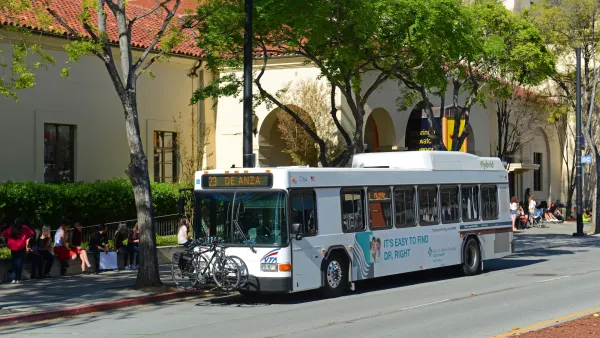
San José’s Buses Run 20% Faster Thanks to AI
The city is employing AI to adjust traffic signals to prioritize buses.
Using Machine Learning to Optimize Utility Management
Discover how machine learning optimizes city utility management for enhanced efficiency and reduced operational costs.

Securing Smart Cities: Financial Cybersecurity in an Urban Age
Explore financial cybersecurity in smart cities, addressing urban vulnerabilities and strategies for protection.

Planetizen Federal Action Tracker
A weekly monitor of how Trump’s orders and actions are impacting planners and planning in America.

California plans to bury El Niño’s downpour
If the state plays its cards right, it may be able to store a billion acre-feet of El Niño’s water in aquifers.

Chicago breaks ground on $3 billion megadevelopment
The new neighborhood, titled Foundry Park, will one day host 3,700 residences.

Satanic Place Names
From streams and lakes to valleys and canyons, I mapped more than 1,000 places named after the Devil.

California High-Speed Rail Authority CEO resigns after $600,000 scandal
Under Ian Choudri, the authority used taxpayer dollars to fund first class flights and trips to nightclubs.

Want to study the Missouri River? Soon, you may need unanimous approval from 10 states
Legislation would require 10 governors’ permission to study or build projects moving water outside the basin.

FREE Course: Walkable City 1: Why Walkability?
After describing his path towards focusing on walkability as the essence of good planning, Jeff Speck marches through his five principal reasons for making more walkable places.
Reinventing Malls: Planning Alchemy—Turning Gray Fields Into Gold
The course focuses on the opportunities and imperatives that shape reinvention of mall sites.

City of Rosemead
Rutgers University, Edward J. Bloustein School of Planning and Public Policy
One Hundred Miles
Hunter College, City University of New York (CUNY)
The Architects Foundation
University of Cincinnati Online
City of Cambridge
Montrose County
The Pocatello Development Authority