As a result of a critical lawsuit that California high-speed rail opponents lost last March, a bill to release $1.1 billion in 2008 bond funds has been advanced to fund high-speed rail 'bookend' projects, particularly Caltrain electrification.


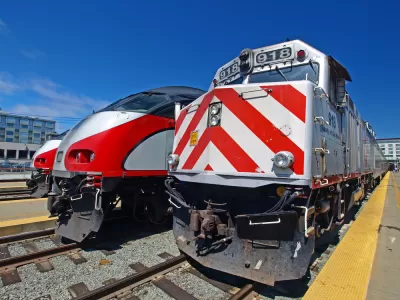
Juliet Williams of the Associated Press writes about new legislation critical to urban transportation improvements in southern California and the Bay Area, particularly electrification of the crowded 55-mile Caltrain commuter line that connects Silicon Valley to San Francisco. The diesel-powered line has the third highest 'ridership per mile' among commuter lines in the United States.
Last March, Sacramento County Superior Court Judge Michael Kenny ruled against Kings County and two Central Valley farmers, who claimed that the California High-Speed Rail Authority's plan violated the will of the voters in 2008 who supported the $9.95 billion bond measure (Proposition 1A) that authorized the San Francisco to Los Angeles high-speed rail project.
While the authority had sold $1.1 billion of those bonds, funds were not released due to litigation that hamstrung the authority.
An amended bill, AB 1889: High-Speed Rail Authority: high-speed train operation, written by Assemblyman Kevin Mullin (D-South San Francisco), would allow those funds to be spent on what are called 'bookend' and connectivity projects because they refer to connecting transit systems at both ends of the line. However, legislation was needed to clarify that these funds are separate and not dependent on the 800-mile line being built.
"What we're trying to clarify is that this does serve the purpose of that but we don't have to wait for the entire corridor of high-speed rail track to be built for the money to be ready to be spent," said Mullin's legislative director, Andrew Zingale.
AB 1889 allows for $1.1 funds to be appropriated to the designated transit agencies.
"This bill would provide for the purposes of that appropriation that the approval by the authority that a corridor or usable segment thereof would be suitable and ready for high-speed train operation is conclusive," states the bill text.
The bill is in the Senate Transportation and Housing Committee having passed the Assembly in its original version that dealt with a different issue.
Other transit agencies that may receive funding from the $1.1 billion include MUNI, BART, Sacramento Regional Transit, Santa Clara Valley Transportation Authority, Altamont Commuter Express, Amtrak San Joaquin corridor, LA Metro, Metrolink, San Diego Trolley, and San Diego Coaster. For more information, see the authority's "High-Speed Rail Connectivity and Bookends" [PDF].
FULL STORY: Bill Would Permit Use of Bullet Train Bonds for Caltrain Upgrade

Caltrain Electrification Broke Ground on Friday
Gov. Jerry Brown, Peninsula congresswomen, including House Minority Leader Nancy Pelosi, and state legislative leaders gathered in Millbrae with shovels-in hands to mark the beginning of a four-year construction project to electrify Caltrain.
Funds Flow to Caltrain Electrification Project
Nothing comes easy for high-speed rail, or anything connected to it, as the agency that runs Caltrain learned in February. But now that a $647 million federal grant has been approved, $713 million in state bond funds will be directed to the project.
More Fallout From Downsizing California High-Speed Rail
A San Francisco Chronicle editorial warns that San Francisco must find funds, intended to come from the state's ambitious rail project, to extend the Caltrain commuter rail line to the SalesForce Transit Center.

Planetizen Federal Action Tracker
A weekly monitor of how Trump’s orders and actions are impacting planners and planning in America.

The state-sanctioned urbicide of Austin
People don’t kill cities. Freeways do.

US to reduce Colorado River water deliveries to Mexico
A new Colorado Treaty amendment reduces Mexico’s Colorado River water allocation by 250,000 acre feet.

Mamdani overhauls NYC's Vision Zero plan with 100 new policy goals
The overhaul aims to reduce traffic deaths and make streets safer for pedestrians, cyclists and drivers through lower speed limits, new safety infrastructure and more.

Amtrak not solely to blame for New Jersey commuter rail's unreliability, report finds
A new study from the Garden State Initiative found that NJ Transit’s budget grew 20% across a 4 year period, but reliability declined significantly over the same period.

EPA erases limits on planet-warming pollution from power plants
Under Monday’s plan, power plants would still have some limits on how much mercury, arsenic and other contaminants they can emit.

FREE Course: Walkable City 1: Why Walkability?
After describing his path towards focusing on walkability as the essence of good planning, Jeff Speck marches through his five principal reasons for making more walkable places.
Reinventing Malls: Planning Alchemy—Turning Gray Fields Into Gold
The course focuses on the opportunities and imperatives that shape reinvention of mall sites.

Eagle County Government
Harvard University Graduate School of Design
Nashville Planning Department
The Architects Foundation
University of Cincinnati Online
The Pocatello Development Authority
The Urban Renewal Agency of the City of Pocatello
Journal of the American Planning Association